The best Loomly alternatives
8 tools, ranked for the reason people leave Loomly. Munshi Social, the AI content marketing engine for small teams, is third here, and the reason is stated under the method and under its own entry.
Prices dated on every entry · Updated September 2026
14-day free trial · No card required · 7-day money-back
If you are leaving Loomly because its new plans cost too much for a team that still needs approvals, SocialPilot is the closest replacement, and Planable is next if client sign-off is the heart of the job. Both keep several seats, many accounts and a review step, which Munshi does not. If you are one or two people running one brand and $65 a month bought a calendar you still had to fill, Munshi is the pick: it writes the posts and the articles for $15 a month. Most people leave Loomly for one reason. The 2025 plan change moved them to Starter or Beyond at renewal, and Starter's caps of 12 accounts and 3 users push a growing team to $249 a month or more.
What sends Loomly customers shopping
These are Loomly's own published terms and the complaints its users repeat in public reviews, stated as fairly as we can. They are not our opinion of the product.
- The 2025 plan change moved every account to new plans at renewal, and Loomly says it cannot restore an earlier plan or offer custom discounts
- Reviewers describe steep renewals: one Capterra reviewer went from $300 to $2,988 a year, and Trustpilot reviewers in May 2026 describe a 315% rise and a doubled bill
- Starter stops at 12 social accounts and 3 users, and clients who only approve count as users, so the next step is Beyond at $249 a month billed yearly or $332 monthly
- Nothing is written unless someone asks the AI, and there is no blog publishing and no keyword plan
- There is no X, and some recent reviewers report scheduled posts that did not go out
The full side-by-side is on Munshi vs Loomly.
8 Loomly alternatives, in order
Every list ranks tools by how completely they do a small business's content marketing. That means five jobs: strategy, writing, publishing to a blog, publishing to social, and measurement. Munshi does all five without a second subscription, which is why it is first on most lists. It is also the youngest, the narrowest on team features, and holds one account per network per workspace. Where the people leaving a tool are leaving for exactly those things, as agencies with many client accounts are, that need outranks the five jobs, the list says so under this line, and Munshi drops to where it belongs. Prices are quoted from each vendor's pricing page and dated. 1,000 posts and 8 networks are Munshi's own numbers, from our pricing page.
Munshi is third here, not first, because most people leave Loomly over what its new plans charge for approvals, seats and accounts, and Munshi has two seats, no client role and one account per network per workspace. It is the right pick only for a one-brand owner with one or two people who left over price and wants the writing done.
-
SocialPilot
SocialPilot is an affordable social media scheduler built for agencies. Plans are sold by account count, from 7 to 50. The higher tiers add client approval through a no-login portal, white-label reports, bulk CSV scheduling and a shared social inbox.
- Best for
- An agency or multi-location brand running many accounts, often several on one network, that needs clients to approve posts and reports that carry its own logo. Premium covers 25 accounts, six users and unlimited client seats for $100 a month.
- Price
- Essentials $30/mo, or $25.50/mo billed yearly. Standard $50, Premium $100 and Ultimate $200 a month, 15% less billed yearly
- The gap
- It publishes what your team writes. AI Pilot drafts one caption at a time on a credit balance, and there is no blog publishing or keyword plan. The $30 Essentials plan has no analytics, inbox or approvals, and annual plans are never refunded.
Pricing and features checked against socialpilot.co/plans, its pricing file for AI agents, its feature pages and its help centre on 30 September 2026
-
Planable
Planable is a collaboration and approval tool for social media teams and agencies. Posts preview the way they will look on each network, and teammates and clients comment, annotate and approve them in place. It is sold per workspace, one per brand or client, with unlimited users.
- Best for
- An agency or brand team whose posts pass through several people before they go out, such as clients, managers or legal. Required approval on Pro and multi-level chains on Enterprise are its core strength. Unlimited users mean a client costs nothing extra to invite.
- Price
- Basic $39/workspace/mo ($33 billed yearly). Pro $59/workspace/mo ($49 yearly). Analytics is a $14/workspace add-on
- The gap
- It does not write the content or publish to a blog. Universal content lets you draft and approve articles and newsletters, but you publish them yourself. Analytics and the inbox are paid add-ons per workspace, and posts are capped at 60 or 150 a workspace a month.
Pricing and features checked against planable.io/pricing, its pricing file for AI agents, its changelog and its help centre on 30 September 2026
-
Munshi Social
Munshi Social is the AI content marketing engine for small teams. It plans the content and writes the articles and the posts. It publishes them to your CMS and your networks and reports the results, all from one weekly approval.
- Best for
- A business where nobody has time to write. The output is the product: 15 articles and 1,000 posts a month, finished and waiting, not a blank editor with an AI button. It suits one or two people running one brand, who would rather read a week's work and say yes than start from an empty composer.
- Price
- $15/mo founding price, locked for life, with two seats and 8 networks and no per-channel fee. Studio runs three brands at $29/mo. The price rises to $49 at public launch.
- The gap
- It holds one account per network per workspace, so four Facebook Pages do not fit. It has two seats, no role hierarchy and five blog destinations (WordPress, Ghost, Webflow, Framer, or Sanity). X is coming soon, the inbox handles comments but not direct messages, and the track record starts in 2026.
Skip us if three or more people touch the posts, a client approves them, or you run several accounts on one network. Munshi has two seats per workspace, only owner and member roles, and one account per network, and that is the setup most Loomly leavers are trying to keep for less. SocialPilot and Planable, above us, both keep it.
Our own pricing page and the app, September 2026
-
SocialBee
SocialBee is a social scheduler built around evergreen recycling. You sort posts into categories and give each one a schedule. It then re-queues the evergreen posts with variations until an expiry date you set. It also has an engagement inbox on every plan and native mobile apps.
- Best for
- A brand with a deep library of evergreen posts, where re-running the best of them is the whole strategy. It also suits anyone who needs more than eight profiles. Plans are sold by profile count, from 5 on Bootstrap to 150 on the largest agency tier.
- Price
- Bootstrap $29/mo, or $24.17/mo billed yearly. Accelerate $49, Pro $99, agency tiers $179 to $449
- The gap
- It is social only. There is no blog publishing and no keyword strategy, only content pillars and a posting rhythm. Post approval starts on Accelerate at $49 a month, so the cheapest plan has no approval step. Analytics history is three months on Bootstrap.
Pricing and features checked against socialbee.com/pricing, its feature pages and its help documentation on 17 September 2026
-
Buffer
Buffer is the lightweight scheduler most people try first. It has a queue, a calendar, clean analytics and a community inbox on every plan. It also has iOS and Android apps, and a free plan that is truly usable, not a demo.
- Best for
- A team that already writes its own posts and wants them queued reliably across two or three channels. It also suits anyone running several accounts on one network, because channels are unlimited on both paid plans. Five Facebook Pages is a normal setup on Buffer and an impossible one in Munshi.
- Price
- Free forever for 3 channels. Essentials $6 per channel a month ($60 a year), Team $12 per channel a month ($120 a year)
- The gap
- It publishes what you bring it. The AI Assistant drafts and reshapes one post at a time while you sit in the composer. There is no blog publishing at any price and no keyword plan. The bill grows with every account: eight channels on Essentials cost $48 a month, or $480 a year. A second login means the Team plan, at double the per-channel rate.
Pricing and features checked against buffer.com/pricing, buffer.com and Buffer's help centre on 17 September 2026
-
Metricool
Metricool is a social media planner with unusually deep analytics. It schedules to eleven networks and puts your ad accounts, your website traffic and up to 100 competitors in the same dashboard. It also has an inbox, a link in bio page, a Looker Studio connector on Advanced, and a free plan that never expires.
- Best for
- A social media manager or agency whose job is reporting, across five or more brands, at a low price per brand. It also suits a one-brand owner who writes their own posts and fits inside 20 a month on the free plan.
- Price
- Free for 1 brand. Starter $20/mo billed yearly ($25 monthly) for 5 brands, or $36 ($45) for 10. Advanced from $53/mo billed yearly ($67 monthly). Prices exclude VAT
- The gap
- It measures what you publish, but it does not write it. The AI assistant drafts one post at a time on 20 credits per brand a month, and there is no blog publishing and no keyword plan. A second login needs Advanced at $53 a month billed yearly, and X is $10 a month per account on every paid plan.
Pricing and features checked against metricool.com/pricing, Metricool's product pages and its help centre on 30 September 2026
-
Later
Later is a visual social media planner that grew up on Instagram. Its users know it for the drag-and-drop grid preview, the Link in Bio page, best-time slots in the calendar and good mobile apps. It publishes to eight networks, and it sits inside a company that also runs influencer campaigns.
- Best for
- An Instagram-first creator or brand that plans the feed by how it looks and writes its own captions. It also suits a small team that wants client approvals, review links and Instagram and Facebook direct messages, from Growth up. Social sets make several brands on one account a normal setup.
- Price
- Starter $18.75/mo billed yearly or $25 monthly, Growth $37.50/mo ($50 monthly), Scale $82.50/mo ($110 monthly). A limited free plan too
- The gap
- It publishes what you write. The AI drafts one caption per credit, from 5 credits a month on Starter, and each profile is capped at 30 posts a month there. Approvals, the inbox and a second user start on Growth. There is no blog publishing, no keyword plan, and its plans are non-refundable.
Pricing and features checked against later.com/pricing, Later's help centre and its about page on 30 September 2026
-
Hootsuite
Hootsuite is the enterprise standard for social media management, sold by the seat. It offers one dashboard for publishing, a unified inbox across networks, social listening, competitor benchmarking, employee advocacy and multi-team approvals.
- Best for
- An organization with a dedicated social team, many accounts across regions or departments, and social customer service at scale. If the job is answering customers on every network from one queue, nothing cheaper on this list truly replaces it.
- Price
- Standard $99 per user a month on annual billing (10 accounts). Professional $199, Advanced $399, Enterprise quoted
- The gap
- Its plans page starts at $99 per user a month on annual billing, for 10 accounts. Every tier assumes a person whose whole job is social. Nothing is written for you, there is no blog publishing, and team approval workflows sit on Advanced at $399 per user a month.
Pricing and features checked against hootsuite.com/plans and its Standard, Professional and Advanced plan pages, plus its analytics, listening, integrations, suite and about pages, on 17 September 2026
Munshi, on the screens that matter here
If you are the one-brand owner who left because the calendar was still empty, here is what fills it, and where you say yes.
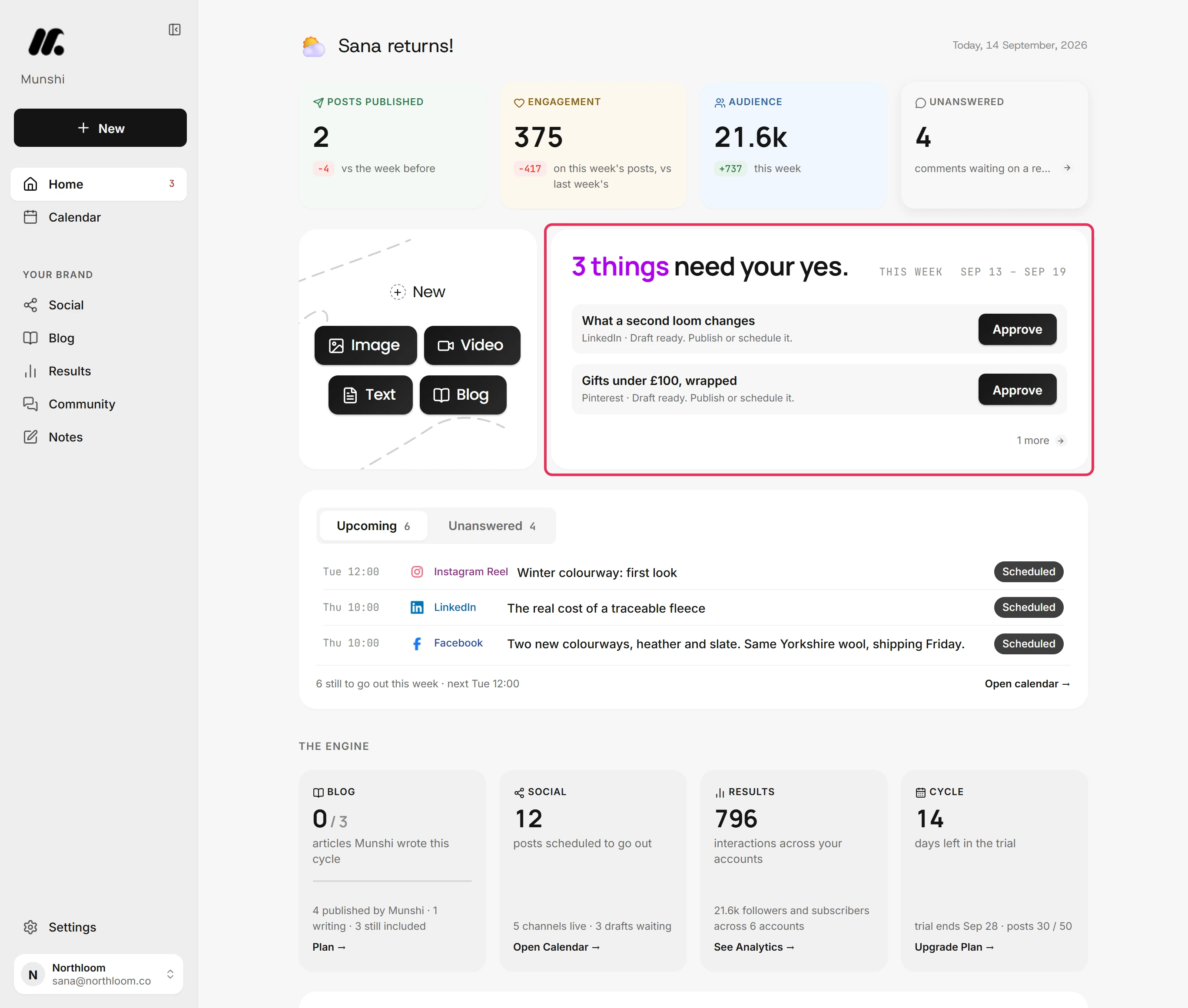
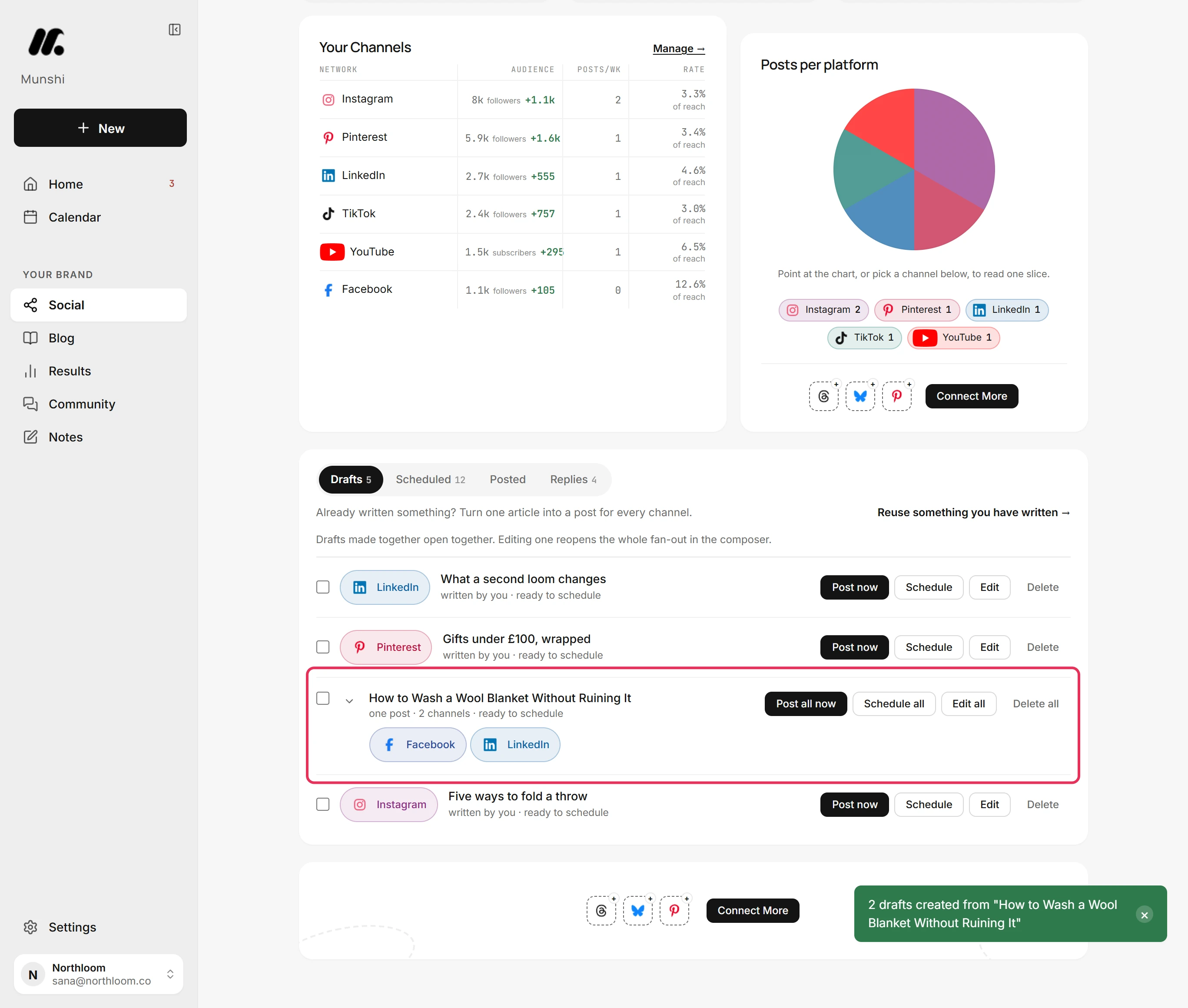
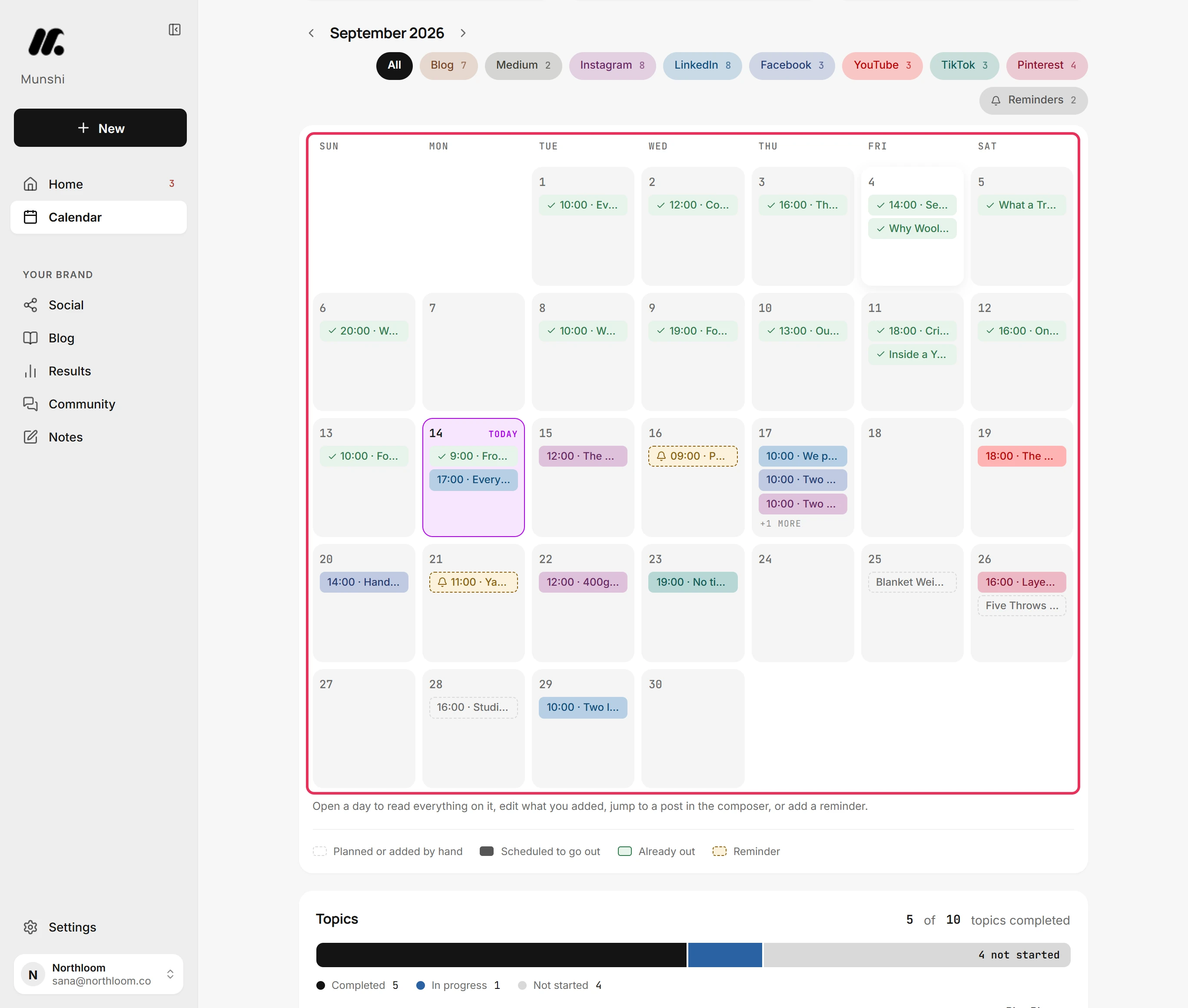
These are real captures from the app, not mock-ups. The walkthroughs behind them are in the docs.
What one weekly sitting looks like when the writing is done for you
Choosing a Loomly alternative, answered
What is the cheapest Loomly alternative that keeps approvals?
SocialPilot and Planable, ranked first and second, are the closest like-for-like swaps, and their entries on this page carry their prices. Among the tools with a full comparison here, SocialBee has post approval from its $49 Accelerate plan, and Buffer's Team plan has approvals at $12 per channel a month. Munshi's approval is one person clearing a weekly batch, with no client role.
Which Loomly alternative lets a client approve posts?
Planable and SocialPilot lead this list for that reason, and their entries carry the detail. Buffer's Team plan adds approvals and custom access controls, and SocialBee's Pro plan gives each workspace three users. Munshi has two seats per workspace and no client role, so if the client logs in to approve, look above us.
Is there a Loomly alternative that writes the posts for me?
Munshi writes them without being asked. It drafts 15 articles and up to 1,000 posts a month from a keyword plan you approved, and they wait in a weekly batch. Loomly's AI Assistant, like the AI in most schedulers here, drafts a post when you open it and ask.
Does any Loomly alternative publish blog articles to my website?
Munshi does, on the base plan: 15 articles a month into WordPress, Ghost, Webflow, Framer, or Sanity. StoryChief, not on this list because it is built for teams that write, publishes to seventeen CMS platforms from $81 a seat a month. Loomly and the other schedulers here publish to social networks only.
Which alternative handles several accounts on one network?
Buffer and SocialBee, which bill by channel or profile count. Loomly itself does it with one calendar per account. A Munshi workspace holds one account per network, so four Facebook Pages need four workspaces, which means more than one Studio plan.
Can I get a refund from Loomly after a price rise?
Loomly's refund policy gives a full refund within 60 days of a yearly payment and 20 days of a monthly one, through a self-serve refund page in the app. The subscription ends as soon as the refund goes through, and calendars go view-only. If a renewal surprised you, check the date of the payment first.
How do I move off Loomly?
Export first. Loomly calendars go view-only when a subscription ends, so download your calendar and reports while you can still edit. Posts already published stay on your own accounts. Then connect those accounts to the tool you picked. For Munshi that takes an afternoon: describe the business, connect the accounts and approve a first strategy.
What do I lose moving from Loomly to Munshi?
Seats, roles and the Client role, custom workflows, direct messages, Google Business Profile, Snapchat, social listening, custom branding, the iOS and Android apps, and a longer refund window. What you gain is the writing: a keyword plan, 15 articles a month on your blog and posts for every network, for $15 a month.
Where every figure on this page comes from
Each price and plan limit above was read on the vendor's own page on the date shown. If a vendor has changed something since, their page is right and this one is out of date.
- Loomly pricing read 30 September 2026
- Loomly about page read 30 September 2026
- Loomly features read 30 September 2026
- Loomly integrations read 30 September 2026
- Loomly help: Plans and pricing update - 2025 read 30 September 2026
- Loomly help: New Free plan read 30 September 2026
- Loomly help: Users and Social Accounts in the pricing table read 30 September 2026
- Loomly help: supported social media platforms read 30 September 2026
- Loomly help: Do you support WordPress? read 30 September 2026
- Loomly help: Custom Channels read 30 September 2026
- Loomly help: AI Assistant read 30 September 2026
- Loomly help: AI Captions read 30 September 2026
- Loomly help: Social Listening read 30 September 2026
- Loomly help: collaboration workflows read 30 September 2026
- Loomly help: roles and permissions read 30 September 2026
- Loomly help: Is Loomly suitable for agencies read 30 September 2026
- Loomly help: custom branding read 30 September 2026
- Loomly help: messages, comments and mentions read 30 September 2026
- Loomly help: post inspiration and RSS feeds read 30 September 2026
- Loomly help: managing a subscription read 30 September 2026
- Loomly help: refund policy read 30 September 2026
- Loomly help: cancelling a subscription read 30 September 2026
- Loomly help: customizing a plan read 30 September 2026
- Loomly help: discounts read 30 September 2026
- Loomly reviews on Capterra read 30 September 2026
- Loomly reviews on Trustpilot read 30 September 2026
The trial is the honest pitch
Describe your business and read what Munshi plans and writes for it. The trial gives you 14 days, 3 real articles and 50 posts, with no card. If the output is not better than what you had, you have lost an afternoon.
Other lists: StoryChief alternatives · Buffer alternatives · SocialBee alternatives · Hootsuite alternatives · Later alternatives · Planable alternatives · CoSchedule alternatives · Metricool alternatives · Blotato alternatives · SocialPilot alternatives · ContentCal alternatives · every comparison