Compare

Munshi vs Hootsuite

Munshi Social, the AI content marketing engine for small teams, side by side with Hootsuite. Hootsuite has been in market since 2008 and is the name most people think of first. It offers one dashboard for publishing, a unified inbox, social listening, competitor benchmarking and team approvals. It is sold per user, to organizations with staff whose job is social.

Pricing and features checked against hootsuite.com/plans and its Standard, Professional and Advanced plan pages, plus its analytics, listening, integrations, suite and about pages, on 17 September 2026

14-day free trial · No card required · 7-day money-back

Pick Hootsuite if you have a social team: it gives them a far deeper desk, with an inbox, listening and a real approval chain. Pick Munshi if you are the social team, because a $99 Hootsuite seat buys tools and still leaves the writing to you. Hootsuite is sold by the seat. Its plans page lists $99, $199 and $399 per user a month on annual billing, and each price assumes a person who runs content. Munshi proposes the plan and writes 15 articles and up to 1,000 posts a month. It waits for one approval, then publishes them to your blog and your networks.

Weighing more than two tools? See the best Hootsuite alternatives in 2026, ranked by how much of the content work each one does for you.

Who they are
Started in 2008. Its about page claims 200K+ users and 6K+ enterprise customers in 200+ countries.
Entry price
Standard, $99 per user a month on annual billing, 10 social accounts
How it is sold
Per user, or seat. You buy extra seats as needed, and annual rates are lower than paying monthly.
Top published price
Advanced, $399 per user a month. Enterprise is quoted.
Free trial
14 days, no card. Trial accounts are capped at 10 to 20 posts a day and cannot bulk schedule.
Blog articles
Not offered. Hootsuite's product areas are publishing, the inbox, listening, analytics, benchmarking and employee advocacy.

What each one actually does

Munshi Hootsuite
Starting price $15/mo founding price, locked for life (rises to $49 at launch) Standard $99 per user a month on annual billing (10 accounts). Professional $199, Advanced $399, Enterprise quoted
What that buys The whole engine: strategy, 15 SEO articles a month, 1,000 posts a month, publishing, analytics One dashboard for scheduling, a unified inbox, listening, benchmarking and team workflows, for content you write yourself
Writes your content? Yes: plans, writes, and grades articles and posts for you AI caption and image generation and a post idea generator in the composer. Wisdom, its AI teammate, drafts and analyses when you ask
Blog articles to your site? Yes: WordPress, Ghost, Webflow, Framer, or Sanity. Articles arrive as drafts you publish from your CMS, except on Sanity, which goes live No. Hootsuite publishes to social channels, not to a website or a CMS
Keyword & content strategy Included: keyword research and a weekly plan you approve Not offered. There is no keyword research or content plan to approve
Social networks 8 networks: Instagram, TikTok, LinkedIn, Facebook, Pinterest, Threads, YouTube, Bluesky Facebook, Instagram, X, LinkedIn, TikTok, YouTube, Threads, Pinterest and Bluesky, plus WhatsApp and Google Business Profile in the inbox. 10 accounts on Standard, unlimited above it
Approval workflow One weekly approval batch. Nothing ships without your yes Team approval workflows and message routing on Advanced, at $399 per user a month
Analytics Every channel in one dashboard, captured daily Deep social analytics and 20-competitor benchmarking, exportable as CSV, XLSX, PDF or PowerPoint. Website numbers only through Enterprise
Free trial 14 days, full engine, no card required 14 days, no card, with daily posting limits and no bulk scheduling during the trial

The rows above, as screens

A comparison table is a set of claims, so here are four screens from the app itself. They show who writes the content, how one idea reaches each network, where the week sits, and what comes back afterwards.

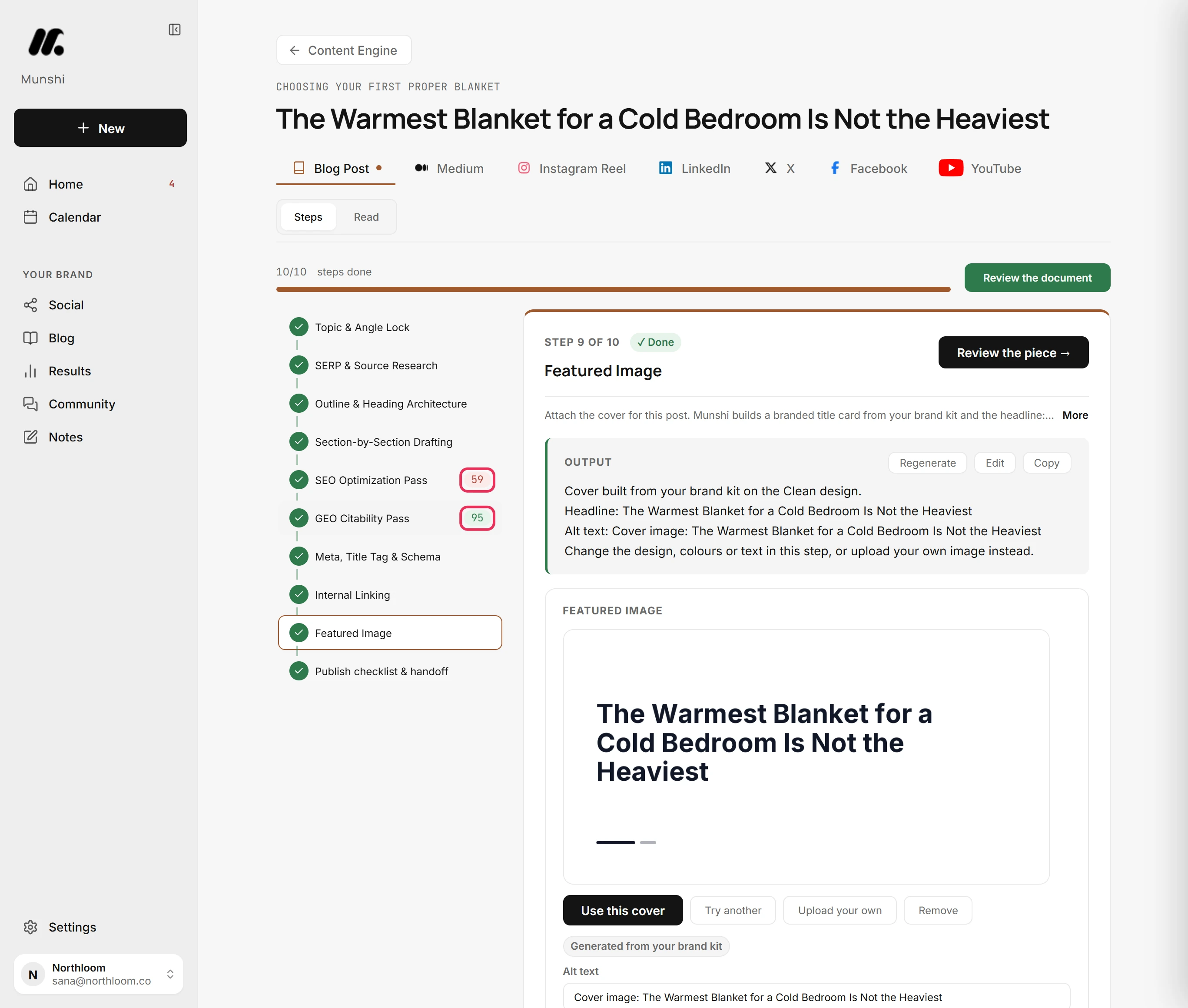
The Munshi article writer with ten steps ticked, SEO Optimization Pass 59, GEO Citability Pass 95, and the Featured Image step open.
Who writes it: ten steps you can read one at a time, two of them scores out of 100.
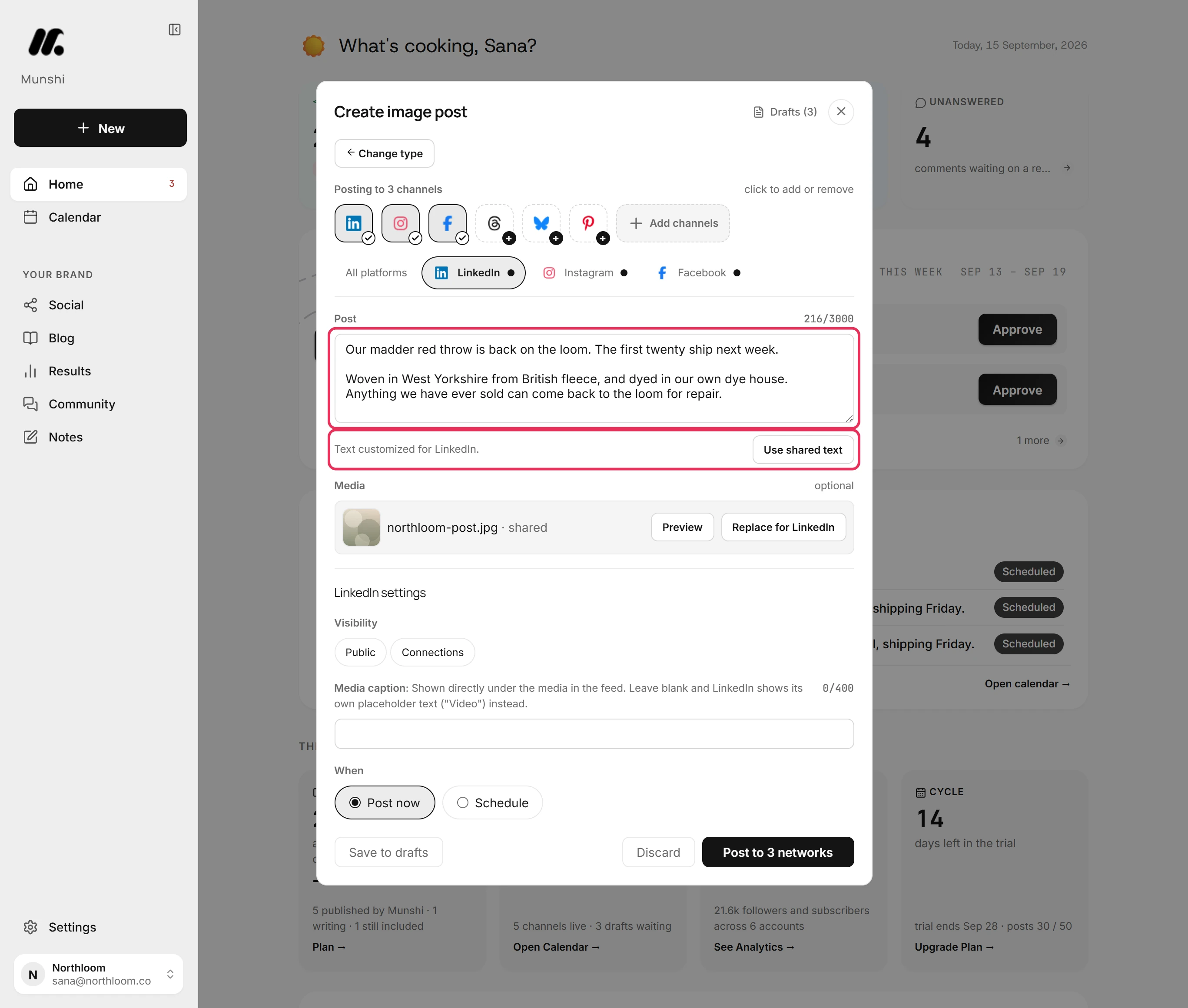
The Munshi composer posting to LinkedIn, Instagram and Facebook, with the LinkedIn tab open, its own caption, and a Use shared text button.
One post gets a tab for each network you picked. Reword the LinkedIn tab and Munshi marks it customized. One button puts the shared text back.
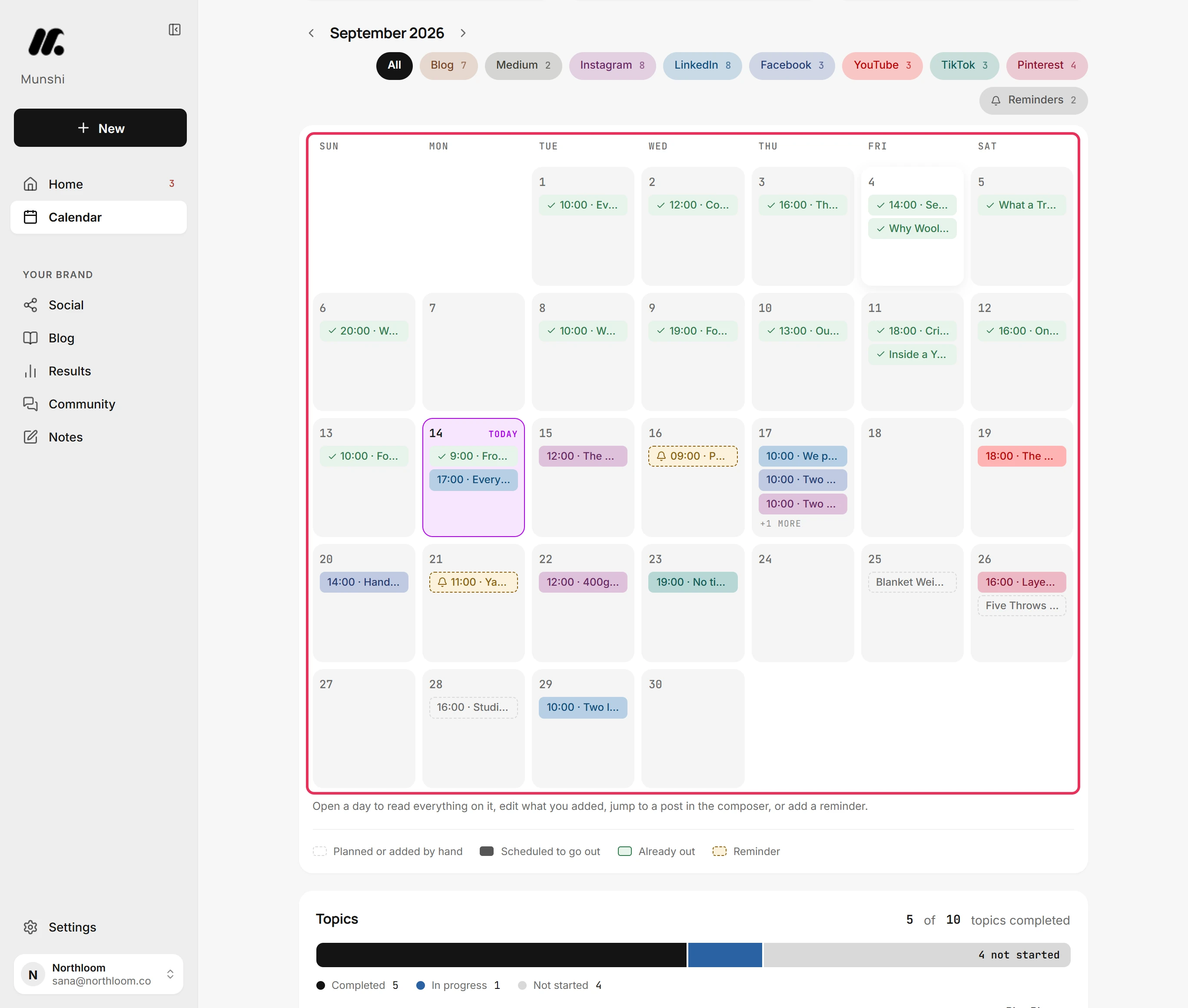
The Munshi calendar for September 2026, with posts and articles on most days, a filter for each channel and a colour key.
Where the week lives: the blog and every connected channel on one month, colour-coded by state.
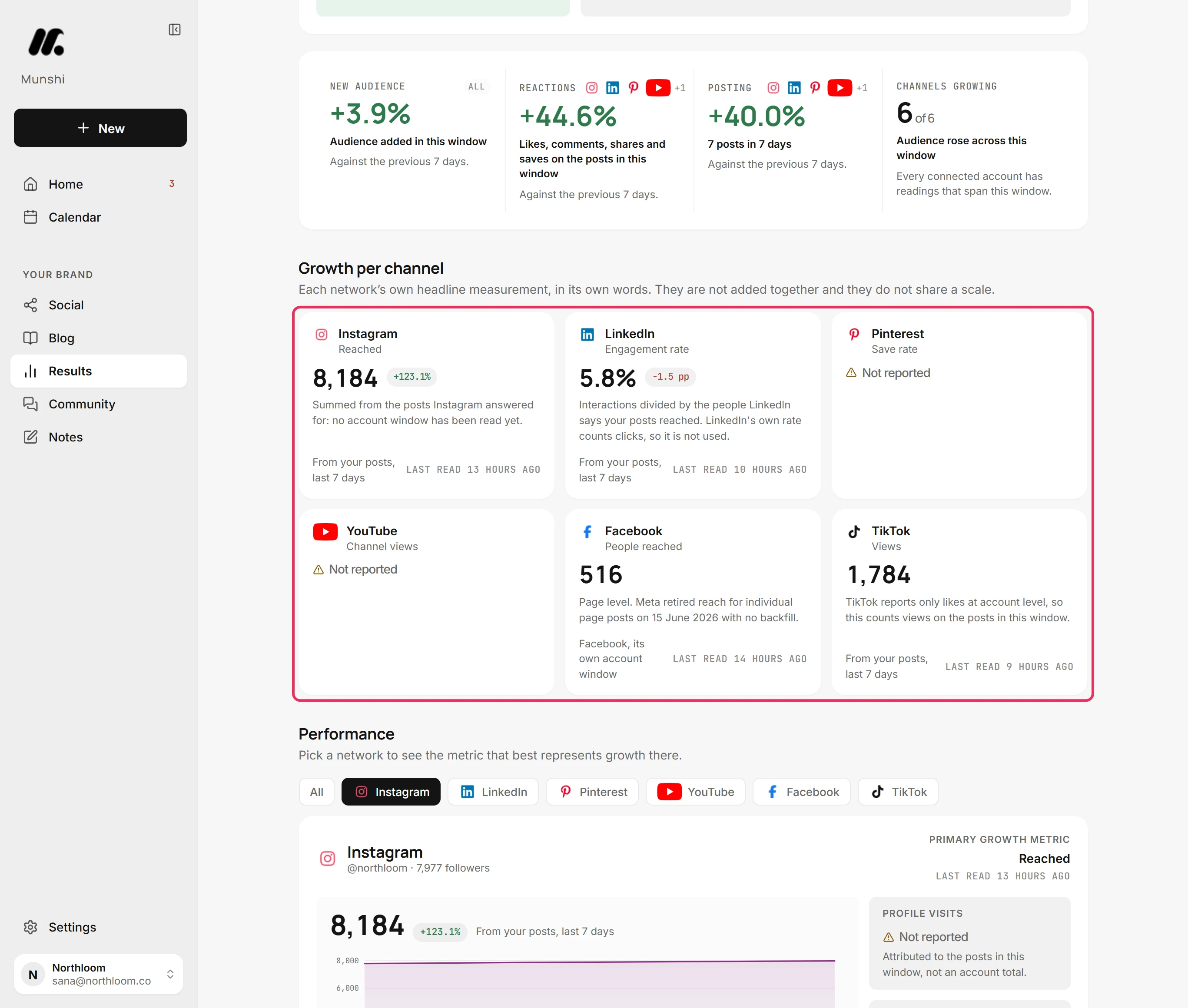
Munshi Results, growth per channel: Instagram reached 8,184, LinkedIn engagement rate 5.8%, Facebook 516 people reached, TikTok 1,784 views, Pinterest and YouTube Not reported.
What comes back: one card per network, in the measure that network reports. Each card shows when it was read, and says Not reported where the network gives nothing.

The differences that decide it

Every comparison on this site answers the rows above. These rows matter only when two tools are this close.

Munshi Hootsuite
Who writes the content Munshi does. It drafts articles and posts from the keyword map you approved and your company profile. They wait in a batch before you open the app. Your team does. Hootsuite's AI writes a caption, suggests post ideas and makes an image while you sit in the composer. Wisdom drafts or summarises when asked. A person still decides what goes out this month.
How the price scales One flat price. All 8 networks, two seats and 15 articles a month are in the $15, and the eighth network costs no more than the first. Per user. One Standard seat is $99 a month on annual billing, and three Advanced seats are three times $399. The account limit lifts at Professional, but the seat price does not fall.
Accounts per network One per workspace: one Instagram, one Facebook Page, one LinkedIn profile or Company Page. Connecting a second account on the same network replaces the first. A second brand needs a second workspace, which means Studio. 10 social accounts on Standard, and unlimited on Professional, Advanced and Enterprise. Facebook profiles, Pages and groups all count, so several Pages for one brand is easy. This is a real advantage over Munshi.
Blog articles 15 a month on Founding, written for you into WordPress, Ghost, Webflow, Framer, or Sanity. Ghost, Webflow, and Framer get them as drafts you publish from your own dashboard. WordPress gets drafts too, except scheduled articles, which go live at their slot. Sanity goes live on schedule. Not part of the product at any tier. Nothing in Hootsuite writes or publishes an article to a website.
Keyword and content strategy Included. Munshi researches keywords, checks demand and proposes a weekly plan. You edit or approve it before anything is written. Not offered as SEO work. Hootsuite gives you social intelligence instead: brand monitoring, sentiment, 30-day social search and trend forecasting on the higher tiers. It also recommends the best times to post.
Seats and roles Two per workspace: an owner and, if a second seat is set up, a member. Only the owner can connect networks, rename, export and handle billing. There are no custom roles and no approver-only seat. As many as you buy, at the plan's per-user rate. Advanced adds team approval workflows, message routing and team performance metrics. Hootsuite is built for this, and Munshi is not.
Approval workflow One weekly batch. Home counts what needs your yes, and each row has the one button that clears it. Nothing unapproved publishes. Team approvals with internal comments on the Advanced plan, plus routing that sends each message to the right person. If a compliance officer must release a post before it ships, this is the mature version of that idea.
Replying to customers A Community inbox for comments, not messages. Comments come in from Instagram, Facebook, Threads, YouTube, Bluesky and a LinkedIn Page. You reply from Munshi on Facebook, Instagram, LinkedIn and Threads, and can remove or hide comments on Instagram and Threads. There are no direct messages, and replies are capped at 20 an hour. A unified inbox for messages and comments across channels, including WhatsApp and Google Business Profile reviews. You can assign a message to a teammate. Professional and up add DM and conversation automations, and Advanced adds routing rules. For social customer service, it is far ahead of Munshi.
Social listening Not offered. Brand monitoring from Standard up, with sentiment analysis and AI summaries included. Professional adds search across the past 30 days of conversations and forecasts of emerging trends up to 90 days ahead.
Employee advocacy Not offered. Parliament, the employee advocacy app in Hootsuite's suite, sends approved content out through staff profiles. Munshi has nothing like it.
Analytics Search Console, Google Analytics and every connected network on one Results page, with Overview, Social and Blog tabs. Windows are 7, 30 or 90 days or custom, and the social report exports as a PDF or Excel file. Where a number cannot be shown, you see a word such as Collecting or Reconnect. Hundreds of social metrics across Facebook, Instagram, TikTok, X, LinkedIn, Pinterest, YouTube and Threads, organic and paid together. It benchmarks against up to 20 competitors, depending on plan, and exports to CSV, XLSX, PDF or PowerPoint. Google Analytics and Adobe Analytics come through Advanced Analytics, an Enterprise add-on.
On a phone The web app rearranges for phone width. A top bar holds the menu and a plus button. A bottom bar holds Home, Calendar, Social, Community and Results, and the composer fills the screen. There is nothing to install. Native iOS and Android apps with Streams, Publisher, Composer and Inbox, so you can publish and answer messages from a phone. That beats Munshi if you work that way.
Billing terms $15 a month or $144 a year. Cancel any time in the Paddle billing portal, with 7-day money back on a first payment. Monthly or annual. Hootsuite's plans page says the annual per-user rates are the lower ones, and it mentions a discounted rate for nonprofits.
Track record Munshi launched in 2026. The team is small and the history is short, and we would rather you knew that. Eighteen years in market, an enterprise tier with SSO and custom compliance, and offices worldwide.

Every plan, both sides

These are published list prices, not what a sales call gets you. We re-check them whenever either vendor changes a price, and the date is at the top of this page.

Hootsuite plans in full

Plan Per user, annual billing Social accounts Users Free trial What it adds
Standard$99/mo101 and up14 daysScheduling, one inbox across eight channels, AI post and image generation, brand monitoring with sentiment and AI summaries
Professional$199/moUnlimited1 and up14 daysInbox and DM automations, custom reports, 30-day social search, 90-day trend forecasting, 20-competitor benchmarking
Advanced$399/moUnlimited1 and up14 daysTeam approval workflows, internal comments, message routing and assignment, team performance metrics
EnterpriseCustomUnlimitedCustomOn requestAdvanced analytics with Google and Adobe Analytics, SSO, custom compliance

Hootsuite is sold per user. A plan price is one seat, so a three-person team pays three times the figure. The rates above are the annual ones its plans page publishes, and paying month to month costs more. Trials take no card, but they cap an organization at 10 to 20 posts a day and switch off bulk scheduling. Publishing covers Facebook, Instagram, X, LinkedIn, TikTok, YouTube, Threads, Pinterest and Bluesky. WhatsApp messages and Google Business Profile reviews arrive in the inbox, not the composer.

Munshi plans in full

Plan Billed monthly Billed yearly Networks Posts Articles Seats
Founding$15/mo$144/yr8, one account each1,000/mo15/mo, written for you2
Studio$29/mo$288/yr8 per brand, 3 brands3,000/mo pooled45/mo across 3 brands2 per workspace
EnterpriseCustomCustom8 per brandSet with the planSet with the plan2 per workspace

Founding pricing is locked for life on the plan and billing cycle you join. Later price rises apply only to new members. Nothing here is priced per seat or per channel. Munshi also keeps each account below the rate networks treat as spam. That means at most 25 posts an hour to any one account. The daily cap is 100 on Instagram and Facebook, 25 on Pinterest and 50 on the rest.

Three situations, with the arithmetic

These are list prices, multiplied out. Do the same sum for your own team before you believe either of us.

One owner, eight accounts, nobody writes

A small business on every network it has an account on, with no one whose job is content.

Hootsuite $99/mo Standard, one seat, annual billing. Ten social accounts, scheduling, the inbox, brand monitoring and AI captions. You still write the posts, and there is no blog.
Munshi $15/mo Founding covers all 8 networks, 1,000 posts and 15 articles a month, written and waiting for one approval.

Here the two products differ most. Hootsuite's $99 is a better dashboard for someone already posting, and Munshi's $15 is the writing. The catch: Munshi holds one account per network, so eight networks means eight accounts, not two Facebook Pages.

A three-person social team with sign-off

A coordinator, a community manager and someone who has to approve before anything goes out.

Hootsuite $1,197/mo Advanced at $399 a seat, three seats, annual billing. Approval workflows, internal comments, message routing and team performance metrics.
Munshi $15/mo, but only two seats A Munshi workspace holds an owner and one member. There are no custom roles and no approver-only seat.

Hootsuite is simply the better tool here, and the price reflects that. If three people need their own logins and a release chain, Munshi cannot do it yet. Splitting the work across workspaces does not help, because each one still has two seats.

A freelancer running three brands

Three clients, their own calendars, and a report for each at month end.

Hootsuite $199/mo Professional, one seat, annual billing. Unlimited social accounts fit all three brands under one login. Custom reports, 30-day social search and no articles.
Munshi $29/mo Studio runs 3 brands with their own connected accounts and calendars, 45 articles and 3,000 posts pooled. Each brand gets its own results, with PDF or Excel export.

Munshi is cheaper and writes the content. Hootsuite gives you an inbox for three brands' messages, listening and competitor benchmarking, and Munshi has no answer to those at all.

Pick Hootsuite if…

  • Someone on the team already writes the content, and what is missing is a proper dashboard
  • You run several accounts on one network, or more than ten accounts in total
  • Social customer service matters: a shared inbox with assignment, WhatsApp and routing rules
  • More than two people touch the content, and a post must be approved before it ships
  • You need listening, sentiment, competitor benchmarking or employee advocacy as part of the job
  • You publish from a phone and want a real iOS or Android app

Pick Munshi if…

  • Nobody is going to write the posts, and a better calendar does not fill an empty one
  • You want blog articles written into your own CMS (the tool your blog runs on), which Hootsuite does not do at any tier
  • You want search numbers and social numbers on one page without an Enterprise contract
  • $15 a month for the content and the publishing is the budget you have
  • One or two people run everything, so paying per seat gains you nothing
  • You want the week planned for you, keywords included, instead of a blank composer

Where each one falls down

A comparison written by one of the two tools is worth reading only if it is willing to lose a row. Here are both lists.

What Hootsuite does not do

  • It does not write your month. The AI writes a caption, an image or a post idea in the composer, and Wisdom drafts and analyses when asked. A person still decides what goes out.
  • There is no blog. Nothing in Hootsuite publishes an article to WordPress, Ghost, Webflow, Framer or anywhere else on your site.
  • No keyword research and no SEO scoring. Website numbers come only through Advanced Analytics on the Enterprise tier. There, the analytics page names Google Analytics and Adobe Analytics, not Search Console.
  • The bill is per seat. On any plan, a second person who needs a login doubles the price.
  • Standard stops at 10 social accounts. More means Professional, at $199 a seat.
  • The trial caps the whole organization at 10 to 20 posts a day and cannot bulk schedule. It gives you a look, not a full month of work.

Hootsuite's own plans, analytics, listening and integrations pages, read 17 September 2026

What we will tell you about Munshi

  • One account per network per workspace. If a brand runs three Facebook Pages or two Instagram accounts, Hootsuite is the right tool and Munshi is not.
  • Two seats and no role chain. There is no screen for adding teammates, no custom permissions, no routing and no approver-only seat.
  • No social listening, no sentiment analysis, no competitor benchmarking, no trend forecasting and no employee advocacy.
  • The Community inbox handles comments, not direct messages. Only Facebook, Instagram, LinkedIn and Threads can be replied to from Munshi, and there is no WhatsApp.
  • No mobile app to install, and no paid social or ad reporting.
  • A small team launched Munshi in 2026, so the track record is months, not years.

Written by the people who build Munshi, September 2026

Munshi and Hootsuite, answered

How much does Hootsuite cost?

Hootsuite's plans page lists Standard at $99 per user a month, Professional at $199 and Advanced at $399, all on annual billing. Enterprise is quoted. Prices are per seat, so a three-person team pays three times the figure, and paying monthly costs more. Checked on hootsuite.com/plans on 17 September 2026.

How many social accounts does each Hootsuite plan include?

Standard includes 10 social accounts, and Professional, Advanced and Enterprise are unlimited. Hootsuite clearly beats Munshi here. A Munshi workspace holds one account per network, so several Facebook Pages or two Instagram accounts for one brand will not fit. Hootsuite handles that without a second thought.

Does Hootsuite have a free plan?

No. The free way in is a 14-day trial with no credit card. Trials are limited to 10 to 20 posts a day for the whole organization, depending on plan, and bulk scheduling is off. Munshi's trial runs 14 days with the full engine, 3 articles and 50 posts, also without a card.

Does Hootsuite write posts for you?

It helps you write them. Hootsuite includes AI captions, an image generator, a post idea generator and Wisdom, an AI teammate that drafts, recommends and analyses on request. It does not decide the month or make the content while you are away. Munshi writes 15 articles and up to 1,000 posts a month from a keyword plan you approved. They wait in a batch for you to open the app.

Can Hootsuite publish blog articles to my website?

No. Hootsuite's product areas are publishing, the inbox, listening, analytics, competitive benchmarking and employee advocacy, and it publishes only to social channels. Munshi writes 15 articles a month into WordPress, Ghost, Webflow, Framer, or Sanity on the base plan. Ghost, Webflow, and Framer get them as drafts you publish from your own dashboard. WordPress gets drafts too, except scheduled articles, which go live at their slot, and Sanity goes live on schedule.

Which networks does Hootsuite support?

Facebook profiles, Pages and groups, plus Instagram, X, LinkedIn, TikTok with a business account, YouTube, Threads, Pinterest and Bluesky. WhatsApp messages and Google Business Profile reviews come into the inbox, not the composer. Munshi connects 8: Instagram, TikTok, LinkedIn, Facebook, Pinterest, Threads, YouTube and Bluesky. Hootsuite adds X, which is coming soon on Munshi. Otherwise the two lists are close, but the account limits are not.

Is Hootsuite good for teams?

Yes, and that is the reason to buy it. Advanced adds team approval workflows, internal comments, automatic message routing and team performance metrics. Its inbox also lets you assign a message to a colleague. Munshi has none of that: a workspace holds an owner and one member, with owner-only controls and one weekly batch that one person approves.

Does Hootsuite do social listening?

Yes. Standard includes brand monitoring with sentiment analysis and AI summaries. Professional adds search across the past 30 days of conversations, trend forecasts up to 90 days ahead and benchmarking against up to 20 competitors. Munshi has no listening at all, so if watching conversations is part of the job, the choice is made.

Does Hootsuite's analytics cover my website?

Only on the top tier. Hootsuite tracks hundreds of metrics across Facebook, Instagram, TikTok, X, LinkedIn, Pinterest, YouTube and Threads, organic and paid together. It exports to CSV, XLSX, PDF or PowerPoint. Google Analytics and Adobe Analytics come through Advanced Analytics, which its analytics page places on Enterprise. Munshi puts Search Console, Google Analytics and every connected network on one Results page in the $15 plan.

Is Munshi a Hootsuite alternative?

Only for part of what Hootsuite does. Munshi plans, writes, schedules, publishes and measures blog articles and social posts for one brand, or three on Studio. It does not replace a shared inbox at scale, social listening, ad reporting or team permissions for six people. If you pay Hootsuite for those, keep paying it. If you pay because content has to go out and nobody has time to write it, Munshi is built for exactly that.

Can I move from Hootsuite to Munshi?

Yes. There is no importer, and little to import, because everything Hootsuite published is on your own accounts. Export any analytics history you want to keep, then disconnect the accounts. Connect them to Munshi, describe your business and approve a first strategy, which takes about an afternoon. Munshi can also import past posts from Bluesky, Facebook, Instagram, LinkedIn, Threads, TikTok and YouTube, so your numbers do not start at zero.

Can I run both?

Yes, and with Hootsuite it makes more sense than with most tools, because the two barely overlap. The trap is publishing: if both schedule to the same Instagram, you get two queues and two sets of numbers. The split that works is Munshi writing and publishing, and Hootsuite handling the inbox and listening on the accounts it already watches.

More on what Munshi does: the blog engine · cross-posting · analytics · pricing