The best StoryChief alternatives
7 tools, ranked by how much of the job each one does. Munshi Social, the AI content marketing engine for small teams, is first, and the reasons to skip it are stated under its own entry.
Prices dated on every entry · Updated September 2026
14-day free trial · No card required · 7-day money-back
If nobody on your team has time to write, Munshi is the closest StoryChief replacement. It writes the articles and the posts, instead of giving a writer a better desk. If you left over price but still employ writers, a scheduler plus your own CMS costs less than either of us. Most people leave StoryChief for two reasons: article publishing costs $81 a seat a month, and the smallest commitment is a quarter.
What sends StoryChief customers shopping
These are StoryChief's own published terms and the complaints its users repeat in public reviews, stated as fairly as we can. They are not our opinion of the product.
- Publishing an article to your own site needs Team Editorial, at $81 a seat a month billed yearly or $97 quarterly. The $22 plan is social only
- Billing is quarterly or yearly with no monthly option, so the smallest commitment is a quarter
- The AI runs on a credit balance that runs out, from 1,000 credits on the entry plan, with add-on packs from $57 a month
- The Editorial tiers include one website per seat, so a second site is another line on the bill
The full side-by-side is on Munshi vs StoryChief.
7 StoryChief alternatives, in order
Every list ranks tools by how completely they do a small business's content marketing. That means five jobs: strategy, writing, publishing to a blog, publishing to social, and measurement. Munshi does all five without a second subscription, which is why it is first on most lists. It is also the youngest, the narrowest on team features, and holds one account per network per workspace. Where the people leaving a tool are leaving for exactly those things, as agencies with many client accounts are, that need outranks the five jobs, the list says so under this line, and Munshi drops to where it belongs. Prices are quoted from each vendor's pricing page and dated. 1,000 posts and 8 networks are Munshi's own numbers, from our pricing page.
-
Munshi Social
Munshi Social is the AI content marketing engine for small teams. It plans the content and writes the articles and the posts. It publishes them to your CMS and your networks and reports the results, all from one weekly approval.
- Best for
- A business where nobody has time to write. The output is the product: 15 articles and 1,000 posts a month, finished and waiting, not a blank editor with an AI button. It suits one or two people running one brand, who would rather read a week's work and say yes than start from an empty composer.
- Price
- $15/mo founding price, locked for life, with two seats and 8 networks and no per-channel fee. Studio runs three brands at $29/mo. The price rises to $49 at public launch.
- The gap
- It holds one account per network per workspace, so four Facebook Pages do not fit. It has two seats, no role hierarchy and five blog destinations (WordPress, Ghost, Webflow, Framer, or Sanity). X is coming soon, the inbox handles comments but not direct messages, and the track record starts in 2026.
Skip to number two if more than two people touch your content, or your site runs on HubSpot, Drupal or Wix. Skip us too if you want editorial control with AI as the assistant. StoryChief is a good tool for a team that writes, and we are the alternative for a business that does not.
Our own pricing page and the app, September 2026
-
Buffer
Buffer is the lightweight scheduler most people try first. It has a queue, a calendar, clean analytics and a community inbox on every plan. It also has iOS and Android apps, and a free plan that is truly usable, not a demo.
- Best for
- A team that already writes its own posts and wants them queued reliably across two or three channels. It also suits anyone running several accounts on one network, because channels are unlimited on both paid plans. Five Facebook Pages is a normal setup on Buffer and an impossible one in Munshi.
- Price
- Free forever for 3 channels. Essentials $6 per channel a month ($60 a year), Team $12 per channel a month ($120 a year)
- The gap
- It publishes what you bring it. The AI Assistant drafts and reshapes one post at a time while you sit in the composer. There is no blog publishing at any price and no keyword plan. The bill grows with every account: eight channels on Essentials cost $48 a month, or $480 a year. A second login means the Team plan, at double the per-channel rate.
Pricing and features checked against buffer.com/pricing, buffer.com and Buffer's help centre on 17 September 2026
-
Metricool
Metricool is a social media planner with unusually deep analytics. It schedules to eleven networks and puts your ad accounts, your website traffic and up to 100 competitors in the same dashboard. It also has an inbox, a link in bio page, a Looker Studio connector on Advanced, and a free plan that never expires.
- Best for
- A social media manager or agency whose job is reporting, across five or more brands, at a low price per brand. It also suits a one-brand owner who writes their own posts and fits inside 20 a month on the free plan.
- Price
- Free for 1 brand. Starter $20/mo billed yearly ($25 monthly) for 5 brands, or $36 ($45) for 10. Advanced from $53/mo billed yearly ($67 monthly). Prices exclude VAT
- The gap
- It measures what you publish, but it does not write it. The AI assistant drafts one post at a time on 20 credits per brand a month, and there is no blog publishing and no keyword plan. A second login needs Advanced at $53 a month billed yearly, and X is $10 a month per account on every paid plan.
Pricing and features checked against metricool.com/pricing, Metricool's product pages and its help centre on 30 September 2026
-
Jasper
Jasper is an AI writing platform for marketing teams. It offers brand voices, knowledge assets, audiences, campaign templates and long-form drafting, with agents for marketing workflows on top.
- Best for
- A marketing team that writes a lot and wants an AI that holds one brand voice across several people. It suits a team that already has a scheduler and a CMS workflow it is happy with. Jasper is the strongest writer on this list by some distance.
- Price
- Pro is $69 per seat a month billed monthly, or $59 per seat a month billed yearly. It includes one seat, 2 brand voices, 5 knowledge assets and 3 audiences. Business is quoted, and there is a 7-day free trial.
- The gap
- It drafts, but it does not plan the calendar, publish to your CMS or your networks, or read the results. You still run the rest of your tools around it and pay for them separately.
Pricing checked against jasper.ai/pricing on 17 September 2026
-
Later
Later is a visual social media planner that grew up on Instagram. Its users know it for the drag-and-drop grid preview, the Link in Bio page, best-time slots in the calendar and good mobile apps. It publishes to eight networks, and it sits inside a company that also runs influencer campaigns.
- Best for
- An Instagram-first creator or brand that plans the feed by how it looks and writes its own captions. It also suits a small team that wants client approvals, review links and Instagram and Facebook direct messages, from Growth up. Social sets make several brands on one account a normal setup.
- Price
- Starter $18.75/mo billed yearly or $25 monthly, Growth $37.50/mo ($50 monthly), Scale $82.50/mo ($110 monthly). A limited free plan too
- The gap
- It publishes what you write. The AI drafts one caption per credit, from 5 credits a month on Starter, and each profile is capped at 30 posts a month there. Approvals, the inbox and a second user start on Growth. There is no blog publishing, no keyword plan, and its plans are non-refundable.
Pricing and features checked against later.com/pricing, Later's help centre and its about page on 30 September 2026
-
SocialBee
SocialBee is a social scheduler built around evergreen recycling. You sort posts into categories and give each one a schedule. It then re-queues the evergreen posts with variations until an expiry date you set. It also has an engagement inbox on every plan and native mobile apps.
- Best for
- A brand with a deep library of evergreen posts, where re-running the best of them is the whole strategy. It also suits anyone who needs more than eight profiles. Plans are sold by profile count, from 5 on Bootstrap to 150 on the largest agency tier.
- Price
- Bootstrap $29/mo, or $24.17/mo billed yearly. Accelerate $49, Pro $99, agency tiers $179 to $449
- The gap
- It is social only. There is no blog publishing and no keyword strategy, only content pillars and a posting rhythm. Post approval starts on Accelerate at $49 a month, so the cheapest plan has no approval step. Analytics history is three months on Bootstrap.
Pricing and features checked against socialbee.com/pricing, its feature pages and its help documentation on 17 September 2026
-
Hootsuite
Hootsuite is the enterprise standard for social media management, sold by the seat. It offers one dashboard for publishing, a unified inbox across networks, social listening, competitor benchmarking, employee advocacy and multi-team approvals.
- Best for
- An organization with a dedicated social team, many accounts across regions or departments, and social customer service at scale. If the job is answering customers on every network from one queue, nothing cheaper on this list truly replaces it.
- Price
- Standard $99 per user a month on annual billing (10 accounts). Professional $199, Advanced $399, Enterprise quoted
- The gap
- Its plans page starts at $99 per user a month on annual billing, for 10 accounts. Every tier assumes a person whose whole job is social. Nothing is written for you, there is no blog publishing, and team approval workflows sit on Advanced at $399 per user a month.
Pricing and features checked against hootsuite.com/plans and its Standard, Professional and Advanced plan pages, plus its analytics, listening, integrations, suite and about pages, on 17 September 2026
Munshi, on the screens that matter here
You came here because articles cost extra. In Munshi, an article costs you one sitting.
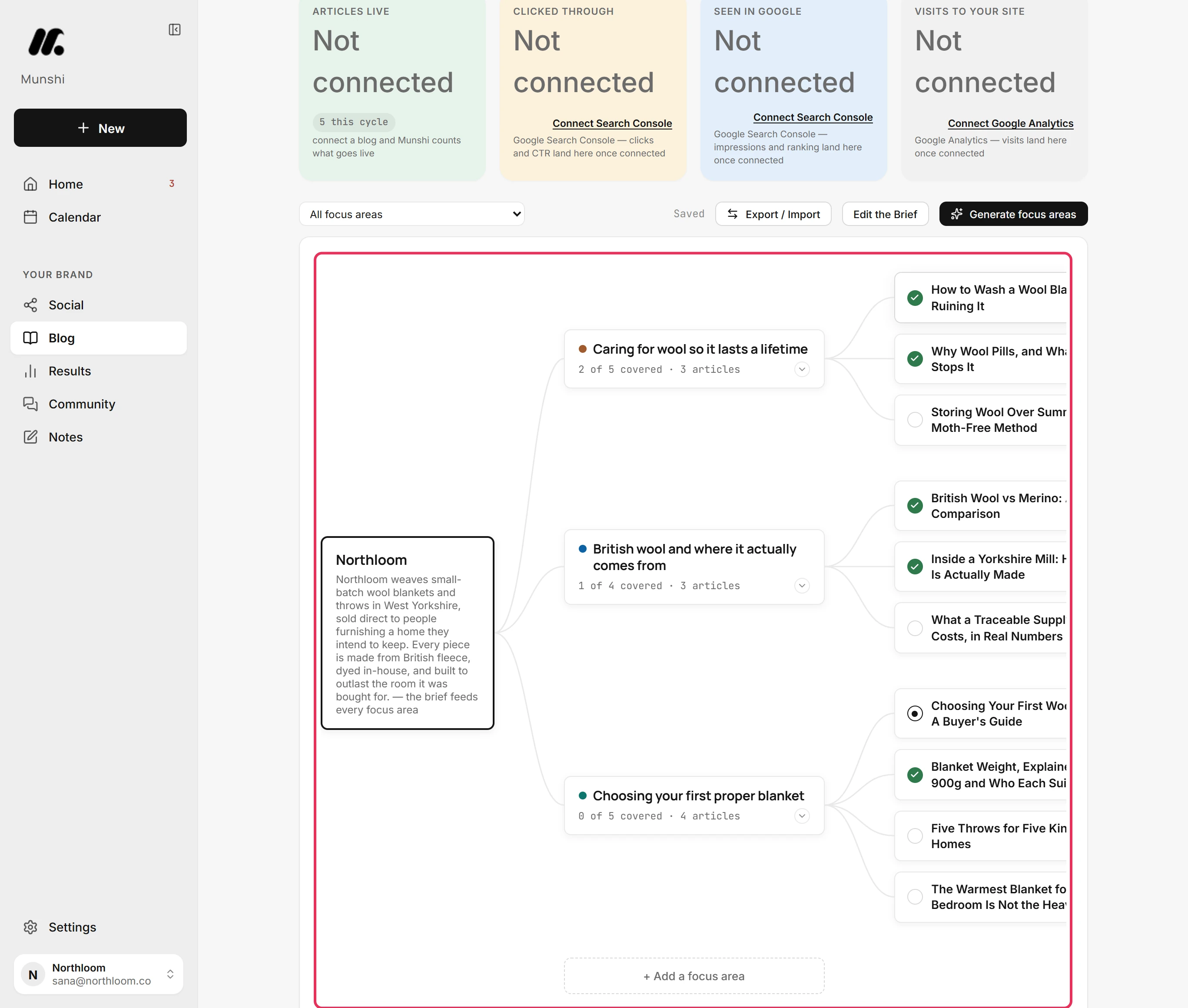
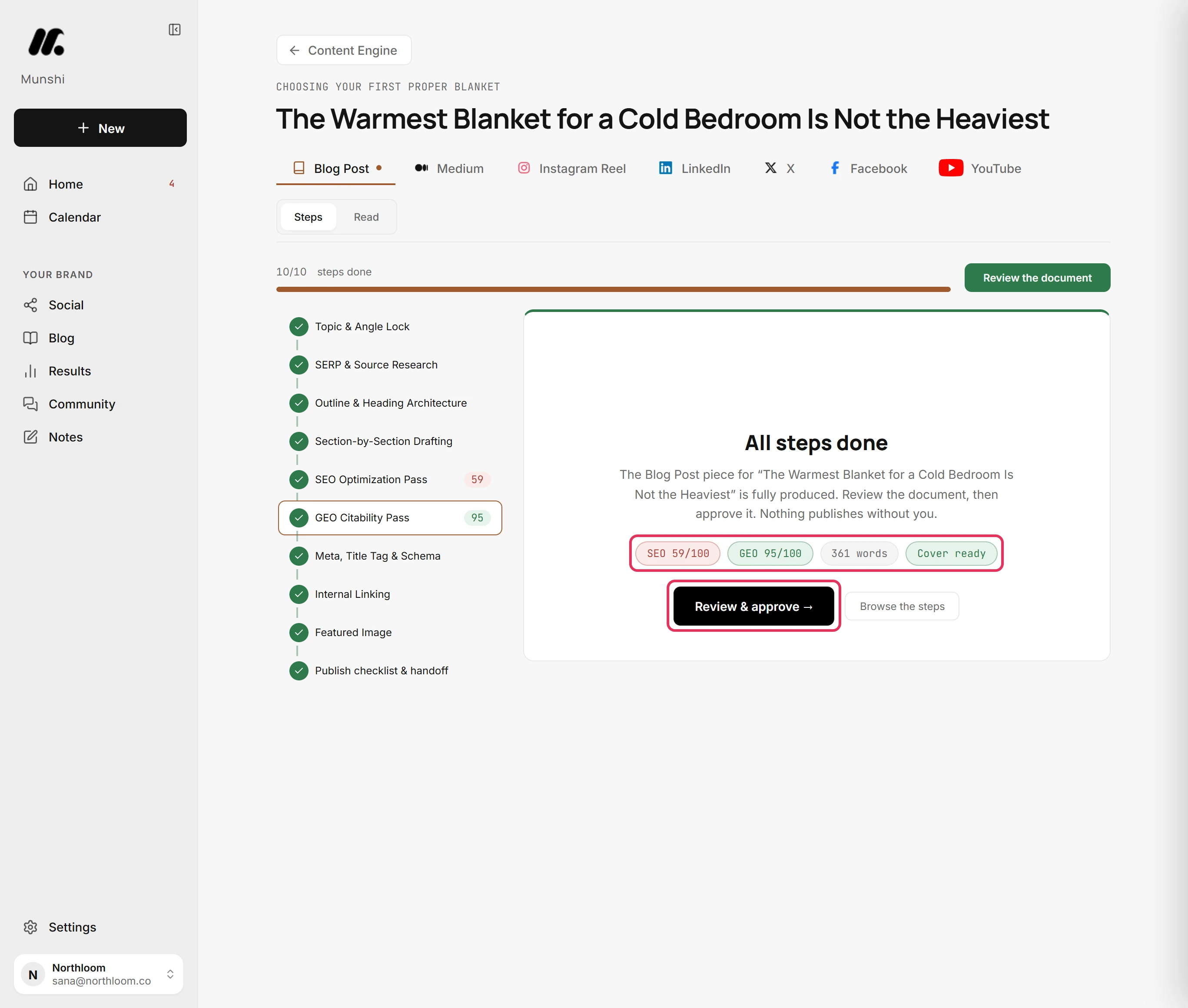
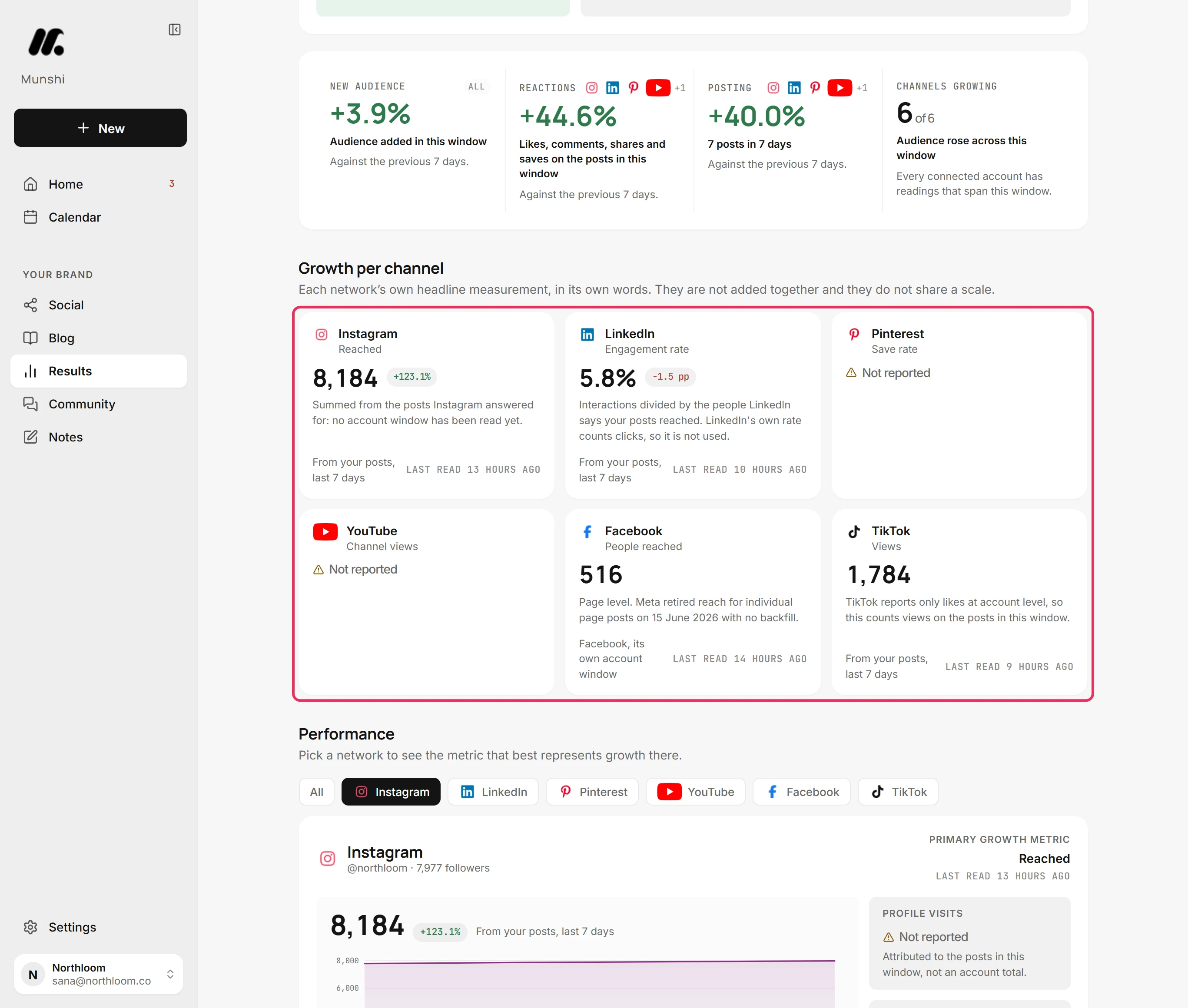
These are real captures from the app, not mock-ups. The walkthroughs behind them are in the docs.
Choosing a StoryChief alternative, answered
What is the cheapest StoryChief alternative that still publishes blog articles?
Munshi, at $15 a month, where 15 articles and 1,000 posts are the plan, not an upgrade. StoryChief's own cheapest route to a published article is Team Editorial, at $81 a seat a month billed yearly or $97 quarterly. Buffer, SocialBee, Later, Metricool and Hootsuite all cost less than $81, but none publishes to a website at any price. So they are not substitutes if the blog is why you are shopping.
Is there a StoryChief alternative that bills monthly?
Yes. Munshi is $15 a month or $144 a year, cancelled from the Paddle billing portal, with 7-day money back on a first payment. Buffer, SocialBee, Metricool and Later all bill monthly too. StoryChief bills only quarterly or yearly, so its smallest commitment is one quarter.
Which alternative is best if my site runs on HubSpot, Drupal or Wix?
None on this list, and that is worth saying plainly. StoryChief publishes to seventeen CMS platforms, including those three, which is more than anyone else here. Munshi publishes to five: WordPress, Ghost, Webflow, Framer and Sanity. If your site runs on a platform we cannot write into, staying on StoryChief is the right answer, even at $81 a seat.
Which alternative works for a team of three or more?
StoryChief, or Buffer's Team plan. Munshi gives a workspace two seats, and the only roles are owner and member. So there is no contributor who drafts and approver who releases. If the review chain is why you bought StoryChief, no price on this list makes up for losing it.
Do any of these write the articles for me, the way StoryChief's AI assists?
Yes. Munshi writes them without being asked: each week it proposes a plan, writes the articles for its keywords and stops for your approval. Jasper writes very well, but only when you ask, and it does not publish anywhere or plan the month. StoryChief's credits sit in between, assisting a person who owns the draft. Everything else on the list schedules what you bring it.
How hard is it to move off StoryChief?
Easier than it sounds. Anything StoryChief published to your own CMS lives on your site, not on theirs, so it stays put. Export anything that sits only in a StoryChief content hub before you cancel. Then connect your CMS and social accounts to the tool you picked. For Munshi that takes an afternoon: describe the business, connect the accounts and approve a first strategy.
The trial is the honest pitch
Describe your business and read what Munshi plans and writes for it. The trial gives you 14 days, 3 real articles and 50 posts, with no card. If the output is not better than what you had, you have lost an afternoon.
Other lists: Buffer alternatives · SocialBee alternatives · Hootsuite alternatives · Loomly alternatives · Later alternatives · Planable alternatives · CoSchedule alternatives · Metricool alternatives · Blotato alternatives · SocialPilot alternatives · ContentCal alternatives · every comparison