Compare

Munshi vs Loomly

Munshi Social, the AI content marketing engine for small teams, side by side with Loomly. Loomly is a social media calendar for brands, agencies and marketing teams, in business since 2015. It is known for a friendly interface, post mockups and approval workflows with a Client role. In 2025 it moved every account to new plans, now Starter, Beyond and Enterprise, and its site footer credits Bending Spoons.

Pricing and features checked against loomly.com/pricing, loomly.com and Loomly's help centre on 30 September 2026

14-day free trial · No card required · 7-day money-back

Pick Loomly if a team and its clients review every post before it goes out: its approval workflows, five roles, Client role and custom workflows are why agencies choose it, and Munshi has nothing that deep. Pick Munshi if you are one or two people running one brand and nobody has time to write, because Munshi writes the posts and the articles instead of handing you a calendar to fill. Loomly is a shared social calendar for ten networks, with an AI Assistant that drafts posts and images when you ask it to. Since its 2025 plan change it starts at $65 a month, or $49 billed yearly, for 12 accounts and 3 users, and the next plan is $332 a month, or $249 billed yearly. Munshi costs $15 a month for 8 networks and two seats. It plans, writes, publishes to your blog and your networks, and reports back. It holds one account per network and has no client role, so it does not replace Loomly for an agency.

Weighing more than two tools? See the best Loomly alternatives in 2026, ranked by how much of the content work each one does for you.

Who they are
Founded in 2015, with 15+ staff and 50k+ customers by its own About page. The site footer credits Bending Spoons.
Entry price
Starter, $65 a month, or $49 a month billed yearly ($588). 12 social accounts, 3 users.
Next plan up
Beyond, $332 a month, or $249 a month billed yearly ($2,988). 60 accounts, unlimited users.
Blog articles
Not offered. WordPress is reachable only through Zapier or as an RSS source.
Free trial
Offered with no card. Loomly does not print its length and says availability varies.
Refunds
A full refund within 60 days on a yearly plan, or 20 days on a monthly one.

What each one actually does

Munshi Loomly
Starting price $15/mo founding price, locked for life (rises to $49 at launch) Starter $65/mo billed monthly, or $49/mo billed yearly ($588). Beyond $332/mo, or $249/mo billed yearly ($2,988). Enterprise is quoted
What that buys The whole engine: strategy, 15 SEO articles a month, 1,000 posts a month, publishing, analytics 12 social accounts, 3 users and unlimited calendars on Starter: a shared calendar with approvals, an inbox and analytics, for posts your team writes
Writes your content? Yes: plans, writes, and grades articles and posts for you On request. An AI Assistant chat and AI captions draft posts, hashtags and images when you ask, from a monthly AI allowance. Nothing is written until someone asks
Blog articles to your site? Yes: WordPress, Ghost, Webflow, Framer, or Sanity. Articles arrive as drafts you publish from your CMS, except on Sanity, which goes live No. WordPress is reachable only through Zapier or as an RSS source, and a blog can be a Custom Channel that reminds you to post by hand
Keyword & content strategy Included: keyword research and a weekly plan you approve Not offered. Post ideas come from holidays, RSS feeds, your own idea lists and the AI chat, with no keyword research
Social networks 8 networks: Instagram, TikTok, LinkedIn, Facebook, Pinterest, Threads, YouTube, Bluesky 10: Facebook, Instagram, LinkedIn, Pinterest, TikTok, YouTube, Threads, Bluesky, Google Business Profile and Snapchat. No X. One account per network per calendar, and calendars are unlimited
Approval workflow One weekly approval batch. Nothing ships without your yes Three built-in workflows, five roles including Client, custom roles, and custom workflows that hold a post until named people sign off
Analytics Every channel in one dashboard, captured daily Post and account analytics with PDF or CSV export on both plans. Scheduled reports on Beyond. Social only
Free trial 14 days, full engine, no card required A free trial with no card required. Loomly does not print its length and says availability varies

The rows above, as screens

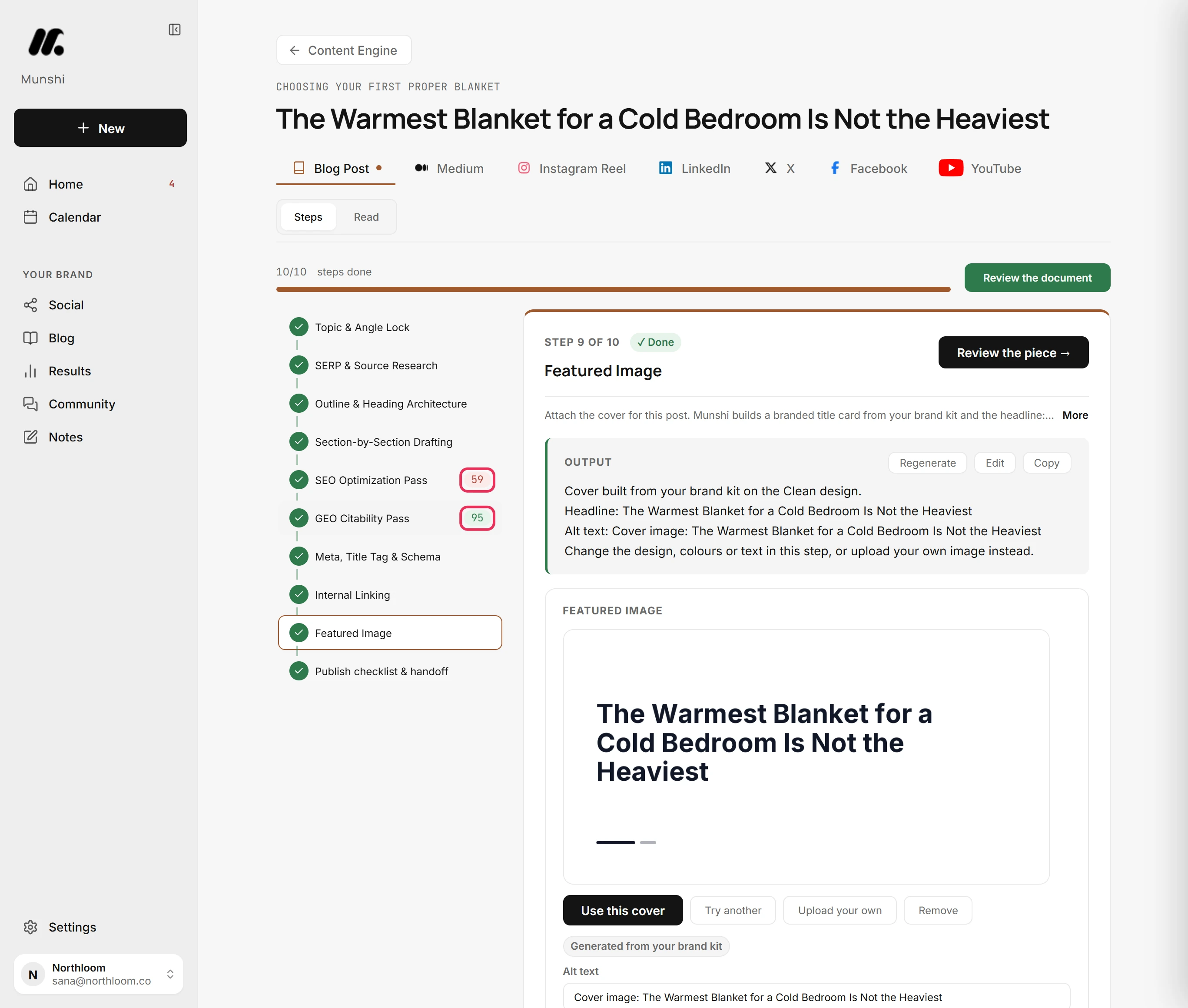
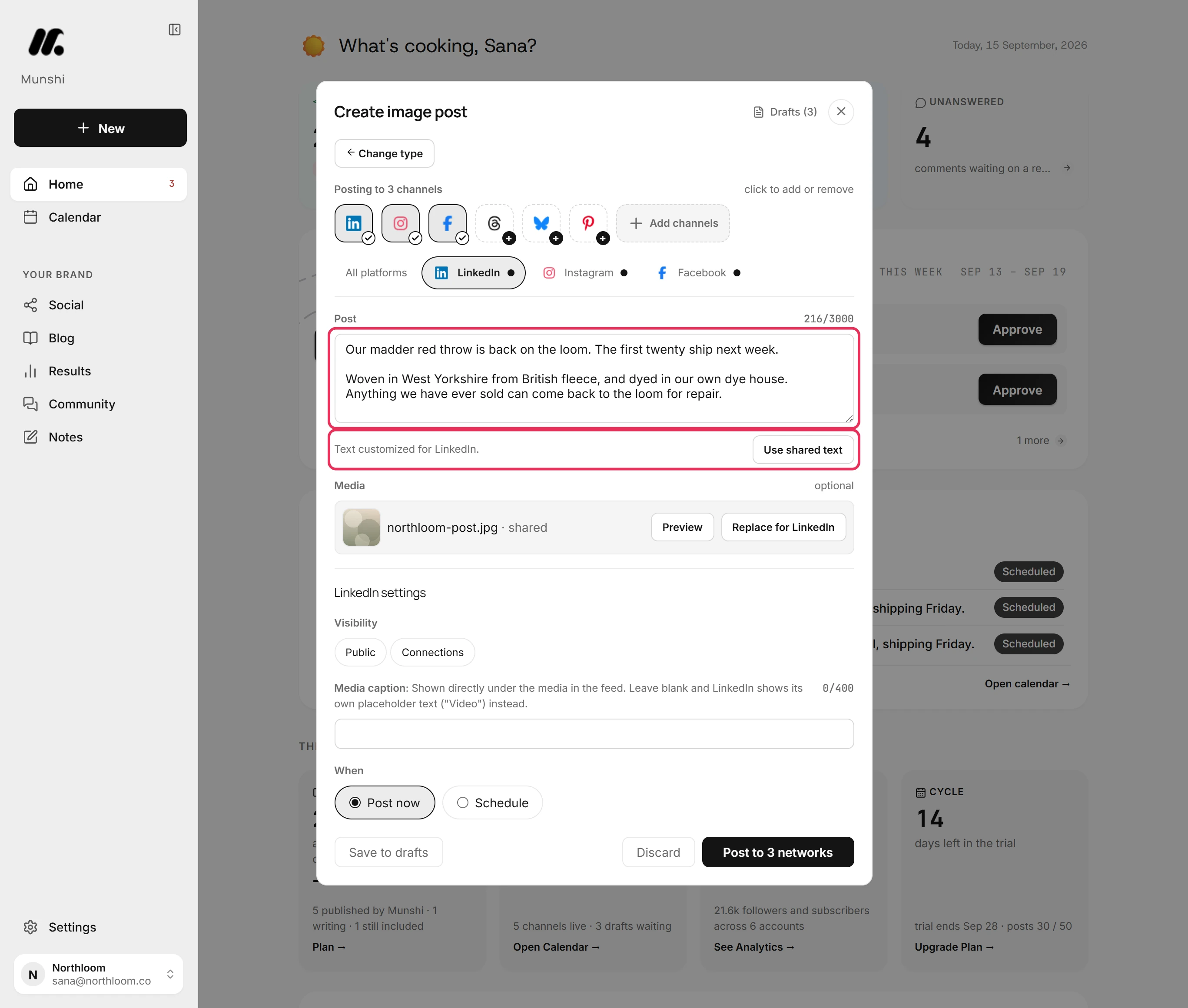
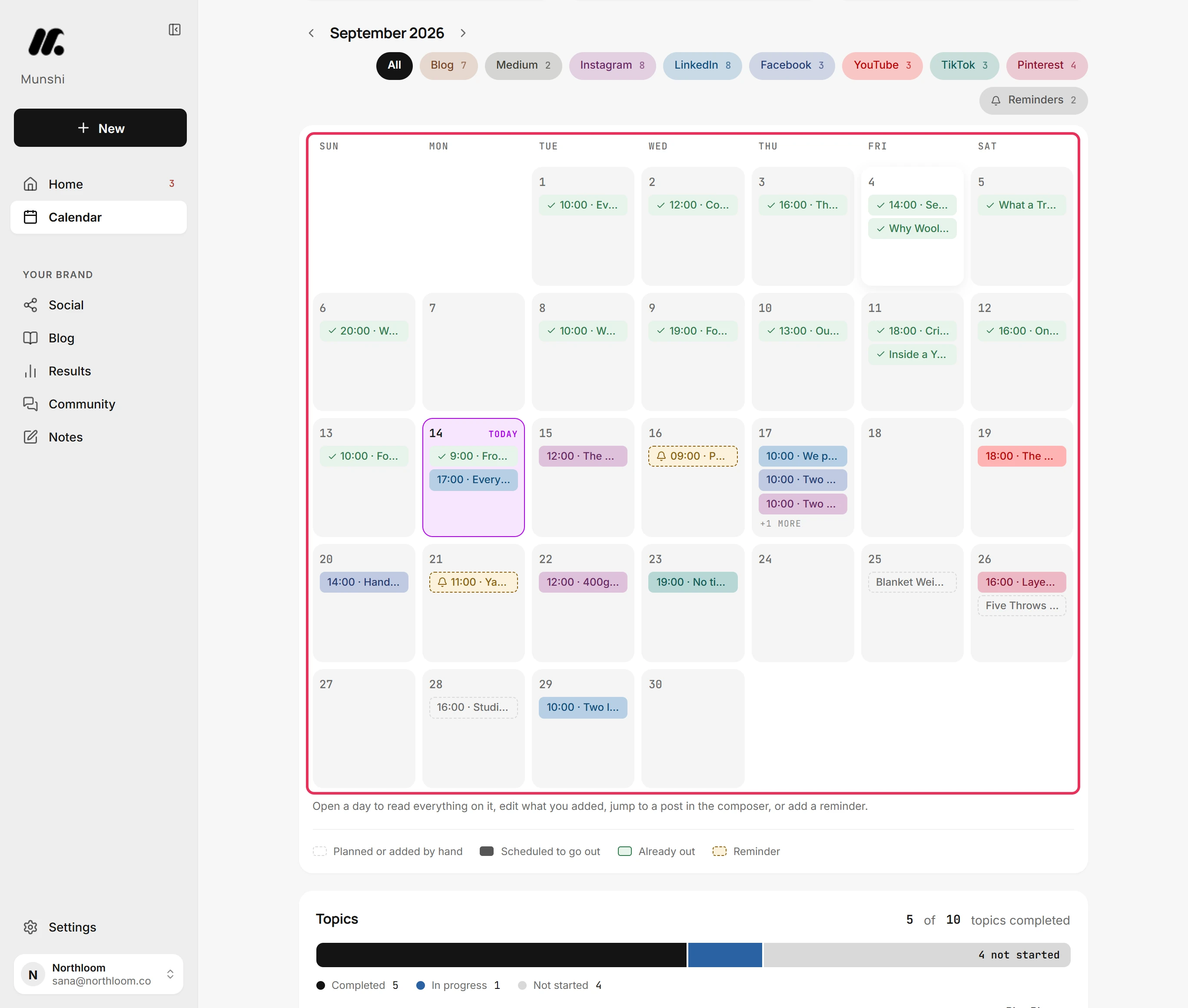
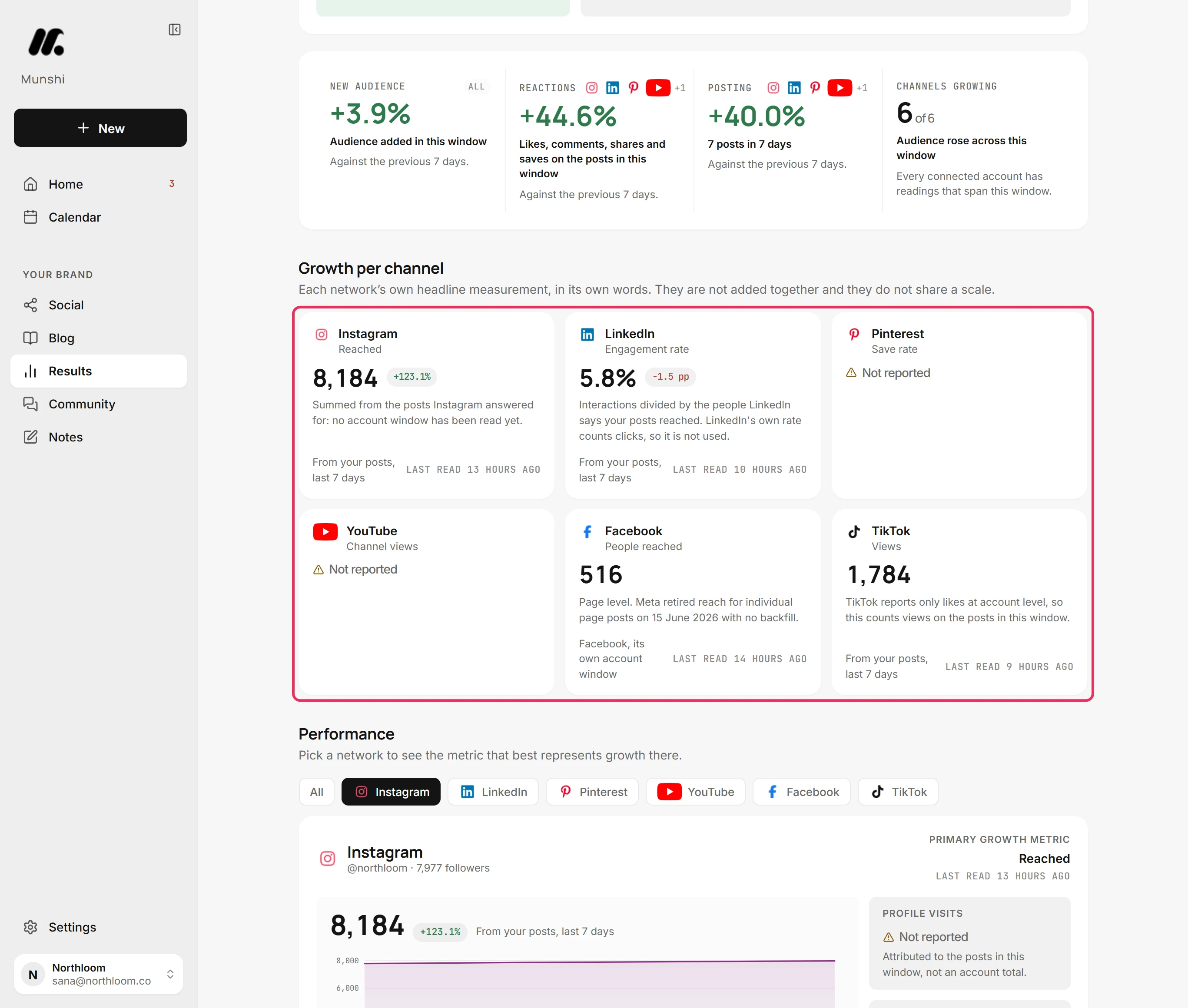
A comparison table is a set of claims, so here are four screens from the app itself. They show who writes the content, how one idea reaches each network, where the week sits, and what comes back afterwards.

The Munshi article writer with ten steps ticked, SEO Optimization Pass 59, GEO Citability Pass 95, and the Featured Image step open.
Who writes it: ten steps you can read one at a time, two of them scores out of 100.
The Munshi composer posting to LinkedIn, Instagram and Facebook, with the LinkedIn tab open, its own caption, and a Use shared text button.
One post gets a tab for each network you picked. Reword the LinkedIn tab and Munshi marks it customized. One button puts the shared text back.
The Munshi calendar for September 2026, with posts and articles on most days, a filter for each channel and a colour key.
Where the week lives: the blog and every connected channel on one month, colour-coded by state.
Munshi Results, growth per channel: Instagram reached 8,184, LinkedIn engagement rate 5.8%, Facebook 516 people reached, TikTok 1,784 views, Pinterest and YouTube Not reported.
What comes back: one card per network, in the measure that network reports. Each card shows when it was read, and says Not reported where the network gives nothing.

Where approval happens in Munshi, set against Loomly's review chain

One list of what needs your yes, one button per row, and nothing published until you press it. It runs 59 seconds and was recorded in the real app. The written steps are in the guide, and the film is also on YouTube.

The differences that decide it

Every comparison on this site answers the rows above. These rows matter only when two tools are this close.

Munshi Loomly
Who writes the content Munshi does. It drafts articles and posts from the keyword map you approved and your company profile. They wait in a batch before you open the app. Your team does, with help. The AI Assistant chat drafts posts, captions, hashtags and images, suggests ideas from what performed well, and rewrites or translates. It works when someone opens it and asks.
How the AI is metered By finished output: 15 articles and 1,000 posts a month on Founding. There is no credit balance. By AI credits per calendar. The pricing page lists limited monthly usage on Starter and extended usage on Beyond, without numbers. The AI Usage panel in each calendar shows the share used.
How the price scales One flat price for all 8 networks and two seats. There is no per-account or per-user fee. In two steps. Starter covers 12 accounts and 3 users. The 13th account or the 4th user means Beyond, at $249 a month billed yearly or $332 monthly. Past 60 accounts, Beyond adds accounts in blocks of 10.
Accounts per network One per workspace: one Instagram, one Facebook Page, one LinkedIn profile or Company Page. A second account on the same network needs a second workspace, which means Studio. One per calendar, but calendars are unlimited and not billed. Three Facebook Pages are three calendars and count as three accounts. For several accounts on one network, Loomly is the better fit.
Who counts as a user Two seats per workspace, included. The only roles are owner and member. Everyone who takes part in a calendar, including a client who only approves posts. One person across several calendars counts once. Starter allows 3 users and Beyond is unlimited.
Blog articles 15 a month on Founding, written for you into WordPress, Ghost, Webflow, Framer, or Sanity. Ghost, Webflow, and Framer get them as drafts you publish from your own dashboard. WordPress gets drafts too, except scheduled articles, which go live at their slot. Sanity goes live on schedule. Not part of the product. A Zapier zap can turn a published caption into a WordPress draft, and an RSS feed can turn your articles into draft social posts. A blog set up as a Custom Channel sends you a reminder to post by hand.
Ideas and strategy Munshi researches keywords, checks demand and proposes a weekly plan. You edit or approve it before anything is written. An Ideas Board, holiday and event prompts, your own post ideas, RSS feeds that can create up to 90 draft posts a month, and the AI chat. That is inspiration for posts, not a keyword plan.
Approval workflow One weekly batch you clear in one sitting. Nothing unapproved publishes. The deeper tool by a distance. Three workflows (two or more approvers, one approver, or none), five roles, custom roles, and custom workflows that auto-assign people and block a post until named users act. Comments can be kept private from clients.
Comments and messages A Community inbox for comments, not messages. Comments come in from Instagram, Facebook, Threads, YouTube, Bluesky and a LinkedIn Page. You reply from Munshi on four of those, up to 20 replies an hour. An inbox on both plans with Facebook comments, mentions and Messenger, Instagram comments, tags and direct messages, LinkedIn and TikTok comments, and Bluesky. It has saved replies, assignment and AI replies. Munshi has nothing for direct messages.
Analytics Search Console, Google Analytics and every connected network on one Results page. Numbers are captured daily, with a flag when a connection breaks. The social report exports as a PDF or Excel file. Post and account analytics, link click tracking and PDF or CSV export on both plans. Scheduled reports to stakeholders need Beyond. The numbers are social only, and Bluesky analytics are listed as coming soon.
Social listening Not offered. A competitor analysis per calendar, with sentiment, mentions and themes. Starter runs 2 a month and Beyond 5.
On a phone The web app rearranges for phone width, with a bottom bar for Home, Calendar, Social, Community and Results. There is nothing to install. Native iOS and Android apps on every plan. This is better if you approve or post from your phone.
Agency setup Studio runs 3 brands on one login, with per-brand PDF and Excel reports at month end. A calendar per client, a Client role, private comments and post mockups. Beyond adds custom branding: your logo, a favicon and a subdomain on myloomly.com.
Billing and refunds $15 a month or $144 a year. Cancel any time in the Paddle billing portal, with 7-day money back on a first payment. Monthly, or yearly at 25% off, charged up front and not ended early. Full refunds within 60 days on yearly plans and 20 days on monthly ones, which is longer than Munshi's 7. Calendars go view-only when a subscription ends.
Track record Munshi launched in 2026. The team is small and the history is short, and we would rather you knew that. In market since 2015, with 50k+ customers by its own count, and its site footer now credits Bending Spoons.

Every plan, both sides

These are published list prices, not what a sales call gets you. We re-check them whenever either vendor changes a price, and the date is at the top of this page.

Loomly plans in full

Plan Billed monthly Billed yearly Social accounts Users Calendars AI usage
Free (help centre only)$0$031Not statedNot included
Starter$65/mo$49/mo ($588/yr)123UnlimitedLimited monthly usage
Beyond$332/mo$249/mo ($2,988/yr)60UnlimitedUnlimitedExtended monthly usage
EnterpriseCustomCustom61+UnlimitedUnlimitedNot stated

The Free plan appears in Loomly's help centre, not on its pricing page: 1 user, 3 accounts and 5 posts a month on a rolling window, and Loomly says it might not be available to everyone. Yearly billing saves 25%, is charged up front and cannot be ended early. A social account is one connection in one calendar, and a calendar holds one account per network, so three Facebook Pages are three accounts. Past 60 accounts, Beyond adds them in blocks of 10. Beyond adds custom branding, scheduled reports and calendar 2FA enforcement. The plan card also lists custom roles and workflows and the hashtag manager as Beyond additions, while the comparison table on the same page marks them included on Starter. Nonprofits get 50% off for life, and first responders and military members 20%.

Munshi plans in full

Plan Billed monthly Billed yearly Social accounts Seats Brands Written for you
Founding$15/mo$144/yr8, one per network2115 articles and 1,000 posts a month
Studio$29/mo$288/yr8 per brand2 per workspace345 articles and 3,000 posts a month, pooled
EnterpriseCustomCustom8 per brand2 per workspaceMore than 3Set with the plan

Founding pricing is locked for life on the plan and billing cycle you join. Later price rises apply only to new members. There is no free plan. The trial runs 14 days with 3 articles and 50 posts, and needs no card.

Three situations, with the arithmetic

These are list prices, multiplied out. Do the same sum for your own team before you believe either of us.

One person, one brand, five networks

A small business owner who wants posts going out and has no time to write them.

Loomly $65/mo Starter: 12 accounts, 3 users, approvals and AI drafting when you ask. It is $49 a month billed yearly, or $588 up front. The Free plan, where it is offered, stops at 3 accounts and 5 posts a month.
Munshi $15/mo Founding. Posts for every network you connect and 15 articles a month, written for you and waiting in a weekly batch.

Starter costs more than four times as much and still leaves the writing to you. If you enjoy writing your own posts, Loomly's calendar is a good one, and the gap matters less.

A team of four with a client who approves

Three people make the posts, and the client signs off before anything is scheduled.

Loomly $332/mo Starter allows 3 users, and Loomly counts a client who only approves as a user, so four people means Beyond. It is $249 a month billed yearly, or $2,988 up front, with unlimited users, the Client role and custom workflows.
Munshi Not a fit Munshi has two seats per workspace and no Client role, so this team does not fit at any price.

Loomly is the better tool here, and this page should not talk you out of it. If Beyond's price is the problem, the answer is a cheaper tool with approvals, not Munshi.

A freelancer with five small clients

Five brands on four networks each, one person doing the work, and clients who read a report rather than log in.

Loomly $332/mo Twenty accounts is past Starter's 12, so it is Beyond: $249 a month billed yearly, or $2,988 a year. Clients could log in and approve at no extra cost.
Munshi $58/mo Two Studio subscriptions cover six brands, each with its own accounts and calendar. Each plan brings 45 articles and 3,000 posts a month, and each brand gets its own results and report.

Munshi costs $58 a month against Loomly's $249 to $332, and it writes the content. What you give up is the client login: in Munshi a client sees the work you send, not a calendar they approve in.

Pick Loomly if…

  • Three or more people touch the posts, including a client who approves them
  • You need a Client role, custom roles, or a workflow that will not schedule a post until named people sign off
  • You run several accounts on one network, such as four Facebook Pages, each in its own calendar
  • You answer Facebook Messenger and Instagram direct messages as well as comments
  • You post to Google Business Profile or Snapchat, or you want iOS and Android apps
  • You want a longer refund window: 60 days on a yearly plan and 20 on a monthly one

Pick Munshi if…

  • Nobody has time to write, and a calendar full of empty days is the real problem
  • You want blog articles written into your own CMS (the tool your blog runs on), which Loomly does not do
  • You are one or two people with one brand, and $65 a month for Starter is more than the job needs
  • You want a keyword plan behind the calendar, not holiday prompts and an idea board
  • You want search and site numbers on the same page as the social ones
  • You would rather clear one weekly batch than run a review chain

Where each one falls down

A comparison written by one of the two tools is worth reading only if it is willing to lose a row. Here are both lists.

What reviewers flag about Loomly

  • Renewals after the 2025 plan change. A Capterra reviewer went from $300 to $2,988 a year with about 30 days' notice, and Trustpilot reviewers in May 2026 describe a 315% rise and a doubled bill. Loomly's help centre says it cannot restore earlier plans or offer custom discounts.
  • Some recent reviewers report scheduled posts that did not go out, and accounts that had to be reconnected before failed posts could be rescheduled.
  • A few recent Trustpilot reviewers call the app slow and dated, and one says you usually solve a problem before support replies.
  • There is no X, which reviewers ask for, and one reviewer tags LinkedIn handles by hand after the post goes live.
  • Starter stops at 12 accounts and 3 users, and clients who only approve count as users, so a growing team jumps to Beyond at $249 to $332 a month.

Public reviews on Capterra and Trustpilot, and Loomly's own pricing page and help centre, read 30 September 2026

What we will tell you about Munshi

  • Two seats per workspace, and the only roles are owner and member. There is no Client role and no custom workflow, so a team of four with a client approver does not fit.
  • One account per network per workspace. Four Facebook Pages need four workspaces, and Studio gives three.
  • The Community inbox reads comments on six networks and replies on four, with no direct messages. Loomly handles Messenger and Instagram direct messages.
  • No mobile app, no Google Business Profile, no Snapchat and no social listening.
  • A small team launched Munshi in 2026, so the track record is short, and the money-back window is 7 days against Loomly's 20 or 60.

Written by the people who build Munshi, September 2026

Munshi and Loomly, answered

How much does Loomly cost?

Starter is $65 a month billed monthly, or $49 a month billed yearly ($588 a year), for 12 social accounts and 3 users. Beyond is $332 a month, or $249 a month billed yearly ($2,988 a year), for 60 accounts and unlimited users. Enterprise is quoted and starts at 61 accounts. Yearly billing saves 25% but is charged up front and cannot be ended early. Prices checked on loomly.com/pricing on 30 September 2026.

Does Loomly have a free plan?

Sometimes. Loomly's help centre describes a Free plan with 1 user, 3 social accounts and 5 posts a month on a rolling window, and says it might not be available to all users. The pricing page does not show it. Munshi has no free plan, only a trial.

Why did Loomly's price go up?

Loomly moved every account to new plans in 2025. Its help centre says the change may include pricing adjustments, that accounts move over at their next renewal, and that it cannot restore earlier plans or offer custom discounts. Reviewers on Capterra and Trustpilot describe large jumps at renewal, in one case from $300 to $2,988 a year. The usual cause is Starter's caps: a 13th account or a 4th user means Beyond.

How long is the Loomly free trial?

Loomly offers a free trial with no card, but it does not print the length, and its help centre says trial availability can vary. Munshi's trial runs 14 days with 3 real articles and 50 posts, also with no card.

Does Loomly write posts for you?

When you ask. The AI Assistant chat drafts posts, captions, hashtags and images, suggests ideas from what performed well, and rewrites or translates what you have. It draws on a monthly AI allowance per calendar. It does not decide what to publish this week. Munshi proposes the plan and writes 15 articles and the posts for every network before you open the app.

Can Loomly publish blog articles to WordPress?

No. Loomly publishes to social networks. Its help centre offers a Zapier zap that turns a published caption into a WordPress draft, and RSS feeds that turn your articles into draft social posts. A blog can also be a Custom Channel, which sends you a reminder to post by hand. Munshi writes 15 articles a month into WordPress, Ghost, Webflow, Framer, or Sanity.

Which networks does Loomly support, and does it support X?

Ten: Facebook, Instagram, LinkedIn, Pinterest, TikTok, YouTube, Threads, Bluesky, Google Business Profile and Snapchat. X is not on the list. Munshi connects 8: Instagram, TikTok, LinkedIn, Facebook, Pinterest, Threads, YouTube and Bluesky. X is coming soon on Munshi, and Munshi has nothing for Google Business Profile or Snapchat.

What counts as a social account and a user in Loomly?

A social account is one connection in one calendar, and a calendar holds one account per network. So three Facebook Pages need three calendars and count as three accounts, though calendars themselves are free. A user is anyone who takes part in a calendar, including a client who only approves posts.

Is Loomly good for agencies?

Yes, it is built for them. Each client gets a calendar, clients get their own role, comments can be kept private, and custom workflows hold a post until the right people approve it. Beyond adds custom branding. The catch is price: an agency past 12 accounts or 3 users pays $249 to $332 a month.

Is Loomly cheaper than Munshi?

No, at every paid size. Starter is $65 a month, or $49 billed yearly, against Munshi's $15. Beyond is $249 to $332 a month against $29 for Studio's three brands. But Loomly's price buys seats, a Client role and approvals that Munshi does not have, and Munshi's buys the writing, which Loomly does not do.

Can I get my money back from Loomly?

Loomly gives a full refund within 60 days of a yearly payment and 20 days of a monthly one, through a self-serve refund page. The subscription ends as soon as the refund goes through, and calendars go view-only. Munshi's money-back window is 7 days on a first payment.

Can I move from Loomly to Munshi?

Yes. There is no importer, and little to import. Posts Loomly already published stay on your accounts. Export your calendar and reports before the subscription ends, because Loomly calendars go view-only after that. Then connect your accounts to Munshi, describe the business and approve a first strategy, which takes about an afternoon. Munshi can also pull in your past posts so Results has history.

More on what Munshi does: the blog engine · cross-posting · analytics · pricing

Where every figure on this page comes from

Each Loomly price, plan limit and feature above was read on Loomly's own pages, or on the review site named, on the date shown. If Loomly has changed something since, its page is right and this one is out of date.